
Sleep Pathways Guild Free RPSGT Exam Prep
Respiratory Events, RERA, UARS, and Pediatric Apnea Scoring with Coach Bob
A practical AASM-aware scenario lab for sleep technologists learning how to study for the RPSGT exam using one-best-option thinking.
Coach Bob Memory Line
“Do not score the story first. Clean the signal, find the event, prove the timing, then document what you saw.”
Free Study Visual: Coach Bob Respiratory Events, RERA, UARS, and Pediatric Apnea Scoring
Use this Sleep Pathways Guild Coach Bob visual to review respiratory-event scoring logic, RERA, UARS, pediatric apnea rules, missed baseline breaths, arousal timing, and SpO₂ trend review.
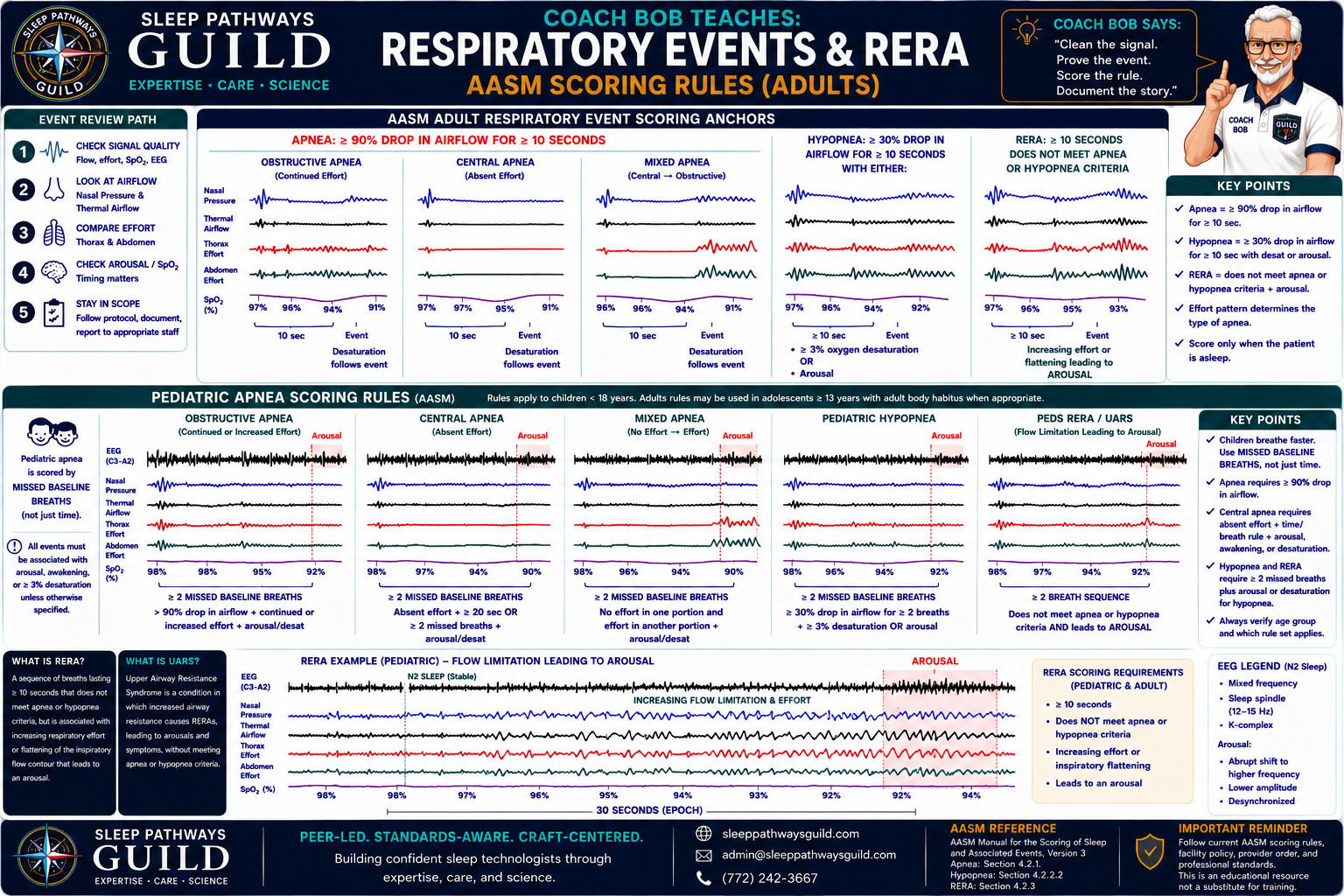
Download the Coach Bob Respiratory Events Visual
This visual is now hosted directly by Sleep Pathways Guild™ for a simpler, safer download experience.
Mini Lesson: How to Study for RPSGT Respiratory Event Questions
Respiratory-event questions can feel tricky because the exam-style scenario may give you several clues at once: nasal pressure, thermal airflow, thorax effort, abdomen effort, oxygen saturation, EEG arousal, sleep stage, body position, PAP leak, snoring, or patient movement. The strongest test-taker does not jump straight to the disorder name. The strongest test-taker follows the data.
Start with signal quality. If the nasal pressure signal is flat because the cannula is out, that is not the same as airflow stopping because the airway is obstructed. If the oximeter is loose, the desaturation pattern may not be reliable. If the effort belts are slipping, effort may be hard to judge. Clean signals protect the patient and protect the study.
Next, ask what changed. Did nasal pressure decrease? Did thermal airflow stop? Did thorax and abdomen effort continue, disappear, or change? Did the event end with an EEG arousal, oxygen desaturation, or both? Was the patient asleep? Was there movement artifact? Was PAP leak making the flow signal unreliable?
For RPSGT exam prep, the best answer is usually the safest and cleanest next step within technologist scope. That may mean fixing a sensor, documenting the observation, following the titration protocol, notifying appropriate staff according to policy, or verifying the scoring context. It does not mean diagnosing the patient, changing therapy outside protocol, prescribing treatment, or promising outcomes.
One-Best-Option Strategy
Ask: Is the signal clean? Is the patient asleep? What changed in nasal pressure and thermal airflow? What happened to thorax and abdomen effort? Did EEG arousal or SpO₂ desaturation support the event? What action stays within technologist scope?
Signal Review Path: Coach Bob’s Respiratory Checklist
- Confirm sleep first. Respiratory scoring belongs in sleep context, not random wake breathing changes.
- Check signal quality. A loose cannula, bad thermal sensor, slipping belt, or poor pulse-ox signal can imitate disease.
- Compare nasal pressure and thermal airflow. Nasal pressure helps show shape and flow limitation. Thermal airflow helps confirm airflow presence or absence.
- Compare thorax and abdomen effort. Effort pattern helps separate obstructive, central, and mixed events.
- Review EEG arousal and SpO₂ trend. Arousal and desaturation must connect to the respiratory pattern when the rule requires it.
- Document safely. Describe what was observed, what was corrected, and what protocol was followed.
Bonus Words of the Day
Bonus Word 1: RERA
RERA stands for respiratory effort-related arousal. In study language, this points to a breathing sequence that increases respiratory effort or shows inspiratory flow limitation and ends in an arousal, but does not meet apnea or hypopnea criteria under the rules being used.
Coach Bob reminder: “A RERA is not a guess. It needs a breathing pattern, an arousal relationship, and a reason it is not already an apnea or hypopnea.”
Bonus Word 2: UARS
UARS stands for upper airway resistance syndrome. It belongs in the sleep-disordered breathing family. The important idea is that the upper airway narrows during sleep, but the pattern may not create obvious obstructive apneas or large oxygen desaturations. Instead, the patient may show increased work of breathing, flow limitation, snoring, repeated arousals, and fragmented sleep.
Coach Bob reminder: “Do not diagnose the label. Describe the pattern.”
Bonus Word 3: Missed Baseline Breaths
Missed baseline breaths is a key pediatric scoring idea. Children breathe faster than adults, so pediatric respiratory-event scoring often uses breath-based duration instead of only adult-style clock time.
Coach Bob reminder: “Adult apnea timing often uses 10 seconds. Pediatric apnea thinking uses missed baseline breaths.”
Mini Lesson: RERA and UARS Are Not Random Arousals
RERA and UARS questions can be confusing because learners may see an arousal and jump to the answer too quickly. The arousal matters, but it must be connected to the breathing pattern. In other words, the EEG arousal should appear after a respiratory sequence showing increasing effort, flow limitation, flattening, snoring, or other supportive respiratory clues depending on the scoring rule and lab policy.
A clean RERA teaching pattern looks like this:
Flow limitation → increasing effort → EEG arousal → does not meet apnea/hypopnea criteria
A UARS teaching pattern looks similar, but UARS is a broader clinical concept. For RPSGT study, think of UARS as repeated upper-airway resistance and increased work of breathing that can fragment sleep. The technologist may observe and document patterns such as flattened nasal pressure, snoring, increased effort, repeated arousals, and relatively limited desaturation. The technologist does not diagnose UARS at the bedside.
AASM-Aware Adult Respiratory Scoring Anchors
The exact scoring manual and facility policy always control. For exam-prep study language, use these anchors to organize your thinking:
| Adult Pattern | Study Anchor | Coach Bob Thought |
|---|---|---|
| Obstructive apnea | Major airflow reduction/absence for the required adult duration with continued or increased respiratory effort. | Airflow stops, but the body keeps trying. |
| Central apnea | Major airflow reduction/absence with absent respiratory effort during the event. | Airflow stops, and effort stops too. |
| Mixed apnea | A single event with both central and obstructive features. | Part no effort, part effort. |
| Hypopnea | Partial airflow reduction for the required duration with the required desaturation and/or arousal rule being used. | Partial drop plus supporting consequence. |
| RERA | Respiratory sequence with increasing effort or flow limitation leading to arousal, not meeting apnea or hypopnea criteria. | Breathing-related arousal, not a random arousal. |
Mini Lesson: Pediatric Apnea Scoring Rules
Pediatric respiratory scoring is different because children breathe faster than adults. A strict adult-style 10-second thinking pattern may miss too many breaths in a child. For pediatric apnea review, the learner should remember the concept of missed baseline breaths.
Pediatric obstructive apnea pattern: Nasal pressure and thermal airflow are absent or greatly reduced while respiratory effort continues or increases. In basic exam-prep language, think: the airway is blocked, but the child is still trying to breathe.
Pediatric central apnea pattern: Nasal pressure and thermal airflow are absent or greatly reduced and respiratory effort is absent. Pediatric central apnea scoring has additional timing and association rules depending on the current scoring manual, patient age, arousal/awakening, oxygen desaturation, and facility policy.
Pediatric mixed apnea pattern: The same event has both central and obstructive features. One part shows absent effort, and another part shows respiratory effort while airflow is still absent or greatly reduced.
Pediatric hypopnea pattern: A pediatric hypopnea involves a partial airflow reduction over the required breath-based duration with the required associated oxygen desaturation or arousal rule being used.
Pediatric RERA pattern: A breathing sequence may show increasing effort or flow limitation and end in arousal without meeting apnea or hypopnea criteria under the scoring rules being used.
Coach Bob’s Pediatric Scoring Reminder
Children breathe faster. Use missed baseline breaths, not just adult clock time. Always check the current AASM scoring manual, facility policy, provider order, patient age, and whether pediatric or adult rules are being applied.
How Not to Overcall the Event
Many RPSGT-style respiratory questions test restraint. The best answer is not always the most dramatic answer. If only one signal changes, review artifact. If the patient is awake, review sleep context. If the cannula is displaced, correct the sensor. If the oximeter waveform is poor, do not blindly trust the desaturation. If PAP leak is excessive, address leak according to protocol before trusting the flow shape.
Coach Bob says: “The event has to earn the score.”
25 RPSGT Practice Questions
Choose the best answer. These are original educational scenarios, not official BRPT exam questions.
- A sleeping adult has a clear drop in airflow of about 90% for at least 10 seconds. Respiratory effort continues throughout the event. What is the best classification?
A. Central apnea
B. Obstructive apnea
C. Wake artifact
D. Periodic limb movementReveal answer
Answer: B. A major airflow reduction with continued effort supports obstructive apnea thinking.
- Airflow is absent for at least 10 seconds and respiratory effort is absent during the event. Which event type is most consistent?
A. Obstructive apnea
B. Central apnea
C. Snore artifact
D. BruxismReveal answer
Answer: B. Absent airflow with absent respiratory effort supports central apnea thinking.
- An event begins with absent respiratory effort and later shows resumed effort before airflow returns. Which event type should the learner consider?
A. Mixed apnea
B. Hypnogram error
C. ECG artifact
D. REM without atoniaReveal answer
Answer: A. A mixed apnea has central and obstructive features during the same event pattern.
- The nasal pressure channel suddenly becomes flat, but the thermal airflow channel still shows breathing and the patient is seen touching the cannula. What is the best first action?
A. Score obstructive apnea immediately
B. Increase PAP pressure outside protocol
C. Check and correct the sensor
D. Diagnose central sleep apneaReveal answer
Answer: C. The best first step is to fix the signal before scoring or interpreting the pattern.
- A respiratory event appears to end with an abrupt EEG frequency shift. What should the technologist review next?
A. Whether the arousal timing supports the respiratory event
B. Whether the patient should have surgery
C. Whether the physician diagnosis is wrong
D. Whether the room temperature caused apneaReveal answer
Answer: A. Respiratory-event scoring often depends on timing relationships among airflow, effort, desaturation, and arousal.
- During PAP titration, leak becomes very high and the flow signal becomes unreliable. What is the best technologist response?
A. Ignore leak because pressure is more important
B. Address mask fit/leak according to protocol
C. Tell the patient PAP will not work
D. Score every flat flow as central apneaReveal answer
Answer: B. Leak can distort airflow signals and therapy delivery, so it should be addressed within protocol.
- A patient has repeated respiratory events mainly while supine. What should the technologist document?
A. The patient has positional OSA as a diagnosis
B. Body position and associated event pattern
C. The patient needs surgery
D. The study is invalidReveal answer
Answer: B. The technologist documents position and observed patterns, while diagnosis belongs to the interpreting provider.
- Which signals are especially helpful when differentiating obstructive from central apnea?
A. Thorax and abdomen respiratory effort channels
B. Room light switch
C. Patient’s pillow brand
D. Bed sheet colorReveal answer
Answer: A. Effort channels help determine whether respiratory effort continues or is absent.
- The oximetry waveform is poor and the SpO₂ value drops suddenly in a square-looking pattern. What should the technologist suspect first?
A. True desaturation without question
B. Possible oximeter artifact
C. REM behavior disorder
D. Sleep spindleReveal answer
Answer: B. Poor pulse-ox signal quality can create false or unreliable desaturation patterns.
- A question asks for the safest next step after a sensor becomes displaced. What is usually the best exam-style answer?
A. Fix or replace the sensor and document
B. Diagnose the patient immediately
C. Stop the study without policy reason
D. Change the physician orderReveal answer
Answer: A. Signal correction and documentation are within the sleep technologist’s role.
- A respiratory event occurs during clear wakefulness. What should the learner remember?
A. Respiratory scoring context matters
B. All wake breathing changes are scored as sleep apnea
C. Wake always equals REM
D. Oximetry should be ignoredReveal answer
Answer: A. Sleep/wake context matters when reviewing respiratory events.
- Which clue supports obstructive respiratory-event thinking?
A. Continued or increased effort with reduced airflow
B. No EEG signal at all
C. Loose pulse oximeter only
D. Patient talking while awakeReveal answer
Answer: A. Continued effort with reduced airflow supports obstructive physiology.
- Which clue supports central respiratory-event thinking?
A. Absent airflow with absent effort
B. Continued snoring with strong effort
C. Mask leak only
D. Leg movement artifactReveal answer
Answer: A. Central events involve reduced or absent airflow with absent respiratory effort during the event.
- A flow-limited breathing sequence ends in an arousal but does not meet apnea or hypopnea criteria. Which term may be considered under appropriate scoring rules?
A. RERA
B. Sleep spindle
C. PVC
D. Alpha intrusion onlyReveal answer
Answer: A. RERA means respiratory effort-related arousal.
- What is the best reason to avoid overcalling respiratory events?
A. Scoring should match evidence and current rules
B. More events always make a better report
C. Overcalling helps the patient get faster surgery
D. The sleep tech should create the diagnosisReveal answer
Answer: A. Accurate scoring depends on evidence, rules, and facility standards.
- During PAP titration, obstructive events continue and leak is controlled. What should the technologist do?
A. Follow the ordered titration protocol
B. Ignore all events
C. Stop PAP permanently
D. Tell the patient they failed therapyReveal answer
Answer: A. PAP adjustments should follow provider order, facility policy, and titration protocol.
- Which documentation phrase is most appropriate?
A. “Patient diagnosed with severe OSA by technologist.”
B. “Repeated obstructive-appearing respiratory events observed while supine; leak addressed per protocol.”
C. “Patient needs surgery.”
D. “Patient refuses to breathe.”Reveal answer
Answer: B. This documents observations and actions without stepping into diagnosis or treatment prescription.
- Which item should be checked before relying on a desaturation?
A. Pulse-ox signal quality
B. Wall clock color
C. Blanket pattern
D. Keyboard brandReveal answer
Answer: A. A reliable oximeter signal is needed before trusting a desaturation pattern.
- The patient removes the PAP mask repeatedly. What is the best first response?
A. Re-educate/reassure within scope and refit as appropriate
B. Force the mask back on
C. Diagnose noncompliance
D. End the study without policy guidanceReveal answer
Answer: A. Sleep technologists provide support and troubleshooting within scope and policy.
- Why is body position useful in respiratory-event review?
A. Events may cluster differently by position
B. It replaces airflow signals
C. It proves diagnosis by itself
D. It makes EEG unnecessaryReveal answer
Answer: A. Position can help describe the pattern of observed events.
- Which combination best supports a respiratory-event scoring decision?
A. Nasal pressure, thermal airflow, effort, oxygen saturation, EEG arousal, and sleep context
B. Patient’s favorite sleep position only
C. One noisy channel only
D. Room number onlyReveal answer
Answer: A. Respiratory review is strongest when multiple reliable signals agree.
- A sudden SpO₂ drop occurs during major movement artifact. What is the best interpretation?
A. Review signal quality before accepting the desaturation
B. Score hypopnea automatically
C. Diagnose hypoventilation
D. Ignore all oxygen data for the rest of the studyReveal answer
Answer: A. Movement artifact can make oximetry unreliable.
- A respiratory event question includes “provider order” and “facility protocol.” Why is that important?
A. Technologists work within orders, protocols, and scope
B. Protocols are optional if the tech disagrees
C. The exam wants the most aggressive treatment
D. It means no documentation is neededReveal answer
Answer: A. Scope, orders, and protocol are central to safe sleep-lab practice.
- Which is the best study habit for respiratory-event questions?
A. Practice tracing the event from signal quality to airflow, effort, arousal/desaturation, and documentation
B. Memorize only disorder names
C. Skip signal quality
D. Always choose the longest answerReveal answer
Answer: A. The best exam prep builds a repeatable review pathway.
- Coach Bob asks, “What is the safest answer?” Which choice best matches his method?
A. Clean the signal, follow the rule, stay in scope, document clearly
B. Guess the diagnosis quickly
C. Recommend surgery
D. Ignore artifactsReveal answer
Answer: A. Safe, clean, rule-based, scope-aware thinking is the best RPSGT exam strategy.
Answer Key
1. B 2. B 3. A 4. C 5. A 6. B 7. B 8. A 9. B 10. A 11. A 12. A 13. A 14. A 15. A 16. A 17. B 18. A 19. A 20. A 21. A 22. A 23. A 24. A 25. A
Flashcards
Flashcard 1: What is the first step before scoring a suspicious respiratory event?
Check signal quality. A bad sensor can imitate a real event.
Flashcard 2: What suggests obstructive apnea thinking?
Marked airflow reduction or absence with continued respiratory effort.
Flashcard 3: What suggests central apnea thinking?
Marked airflow reduction or absence with absent respiratory effort.
Flashcard 4: What is a mixed apnea pattern?
An event with both central and obstructive features.
Flashcard 5: Why does PAP leak matter?
Leak can affect signal quality, patient comfort, and therapy delivery.
Flashcard 6: What does RERA stand for?
Respiratory effort-related arousal.
Flashcard 7: What does UARS stand for?
Upper airway resistance syndrome.
Flashcard 8: What is UARS study language?
Upper airway narrowing with increased work of breathing, flow limitation, arousals, and sleep fragmentation.
Flashcard 9: What is the pediatric apnea timing memory point?
Pediatric apnea thinking uses missed baseline breaths, not only adult-style clock time.
Flashcard 10: Why should the RERA arousal be connected to the respiratory channels?
Because RERA means a respiratory effort-related arousal. The arousal should relate to the breathing sequence.
Flashcard 11: What should a technologist avoid saying?
A technologist should avoid diagnosing, prescribing, or promising treatment outcomes.
Flashcard 12: Coach Bob’s event review order?
Clean signal → nasal pressure/thermal airflow → effort → EEG arousal/SpO₂ trend → scope-safe documentation.
Glossary
Apnea: A major reduction or absence of airflow for a defined duration according to current scoring rules.
Obstructive Apnea: A respiratory event pattern with absent or markedly reduced airflow while respiratory effort continues.
Central Apnea: A respiratory event pattern with absent or markedly reduced airflow and absent respiratory effort.
Mixed Apnea: A respiratory event with both central and obstructive features.
Hypopnea: A partial reduction in airflow associated with required scoring features such as desaturation and/or arousal, depending on the rule being used.
RERA: Respiratory effort-related arousal; a breathing sequence associated with increased effort or inspiratory flow limitation ending in arousal that does not meet apnea or hypopnea criteria under the scoring rules being used.
UARS: Upper airway resistance syndrome; a sleep-disordered breathing pattern associated with increased upper-airway resistance, increased work of breathing, flow limitation, arousals, and sleep fragmentation.
Arousal: A brief EEG change that may interrupt sleep and may be associated with respiratory events, limb movements, noise, or other causes.
Desaturation: A drop in oxygen saturation measured by pulse oximetry.
Nasal Pressure: A respiratory signal often used to evaluate airflow shape, reduction, and inspiratory flattening.
Thermal Airflow: A respiratory signal from a thermistor or thermocouple that helps show airflow presence or absence.
Thorax and Abdomen Effort: Respiratory effort channels that help separate obstructive, central, and mixed breathing patterns.
Flow Limitation: A breathing pattern suggesting restricted airflow, often reviewed using nasal pressure shape and supporting channels.
PAP Leak: Air leak from the mask or system that may affect comfort, signal quality, and therapy delivery.
Pediatric Apnea Scoring: Respiratory-event scoring in children that considers missed baseline breaths, patient age, effort pattern, arousal/awakening, desaturation, and current scoring rules.
Technologist Scope: The professional boundary in which the sleep technologist collects data, supports the patient, follows protocol, documents observations, and avoids diagnosing or prescribing.
Artifact: A signal problem that can mimic or obscure physiologic data.
References and Study Resources
For books and study references mentioned in Sleep Pathways Guild articles, visit the Sleep Pathways Guild RPSGT Exam Prep Book Store. The store includes curated sleep technology, pediatric sleep, scoring, PSG, and sleep medicine study references.
- Fundamentals of Sleep Technology — useful for sleep technologist foundations, respiratory-event review, pediatric scoring concepts, PAP support, and documentation.
- Polysomnography for the Sleep Technologist — useful for PSG signals, equipment setup, monitoring, troubleshooting, and lab procedure concepts.
- Pediatric Sleep Medicine resources — useful for pediatric sleep-disordered breathing, childhood apnea patterns, airway anatomy, and pediatric PSG context.
- Sleep medicine review resources — useful for broader sleep-disorder foundations and clinical vocabulary.
- Current AASM Scoring Manual — use the current version followed by your facility for official scoring rules, terminology, technical specifications, and pediatric/adult respiratory scoring criteria.
- BRPT Candidate Handbook and Current Exam Blueprint — use for exam-domain alignment and RPSGT study planning.
Visit the Sleep Pathways Guild RPSGT Book Store
Affiliate disclosure: Sleep Pathways Guild may earn from qualifying purchases through links shared on the book store page, at no extra cost to you.
Coach Bob Final Review
Respiratory-event questions are not just about memorizing apnea, hypopnea, RERA, and UARS definitions. They are about pattern recognition. The RPSGT learner should practice moving from signal quality to event type, from event type to timing support, and from timing support to safe documentation.
Coach Bob says: “The cleanest signal gives the clearest answer. When the signal is messy, fix the signal before you trust the pattern.”
Disclaimer
Educational summary only. Follow current AASM scoring rules, facility policy, provider order, and applicable professional standards. Sleep Pathways Guild is not affiliated with or endorsed by BRPT, AASM, AAST, or Pearson VUE. These are original educational scenarios for study and review. They are not official BRPT exam questions. Sleep technologists do not diagnose, prescribe, or recommend treatment. They collect quality data, follow protocol, support patient safety, and document observations.
Linked references & resources
Official sources are prioritized. Book links open Amazon search results so readers can compare available editions.
Affiliate disclosure: As an Amazon Associate I earn from qualifying purchases. Book links marked “paid link” may generate a commission at no additional cost to you.
- Fundamentals of Sleep Technology — view available editions on Amazon (paid link)
Verify the title, author, and edition before purchasing. - Polysomnography for the Sleep Technologist — view available editions on Amazon (paid link)
Verify the title, author, and edition before purchasing. - AASM Scoring Manual — official page
Use the current version followed by your facility. - BRPT RPSGT Exam Blueprint
Official exam-domain outline.