
RPSGT Exam Practice: Recognizing Snore Artifact on PSG
Sleep Pathways Guild Study Tip: In the sleep lab, artifact recognition is not just about finding a messy signal. It is about asking, “What channel explains the pattern?”
Practice Question
Scenario: During an attended overnight polysomnogram, the technologist observes repetitive bursts of activity contaminating the EEG and chin EMG channels. The bursts appear at the same time as large activity in the snore channel.
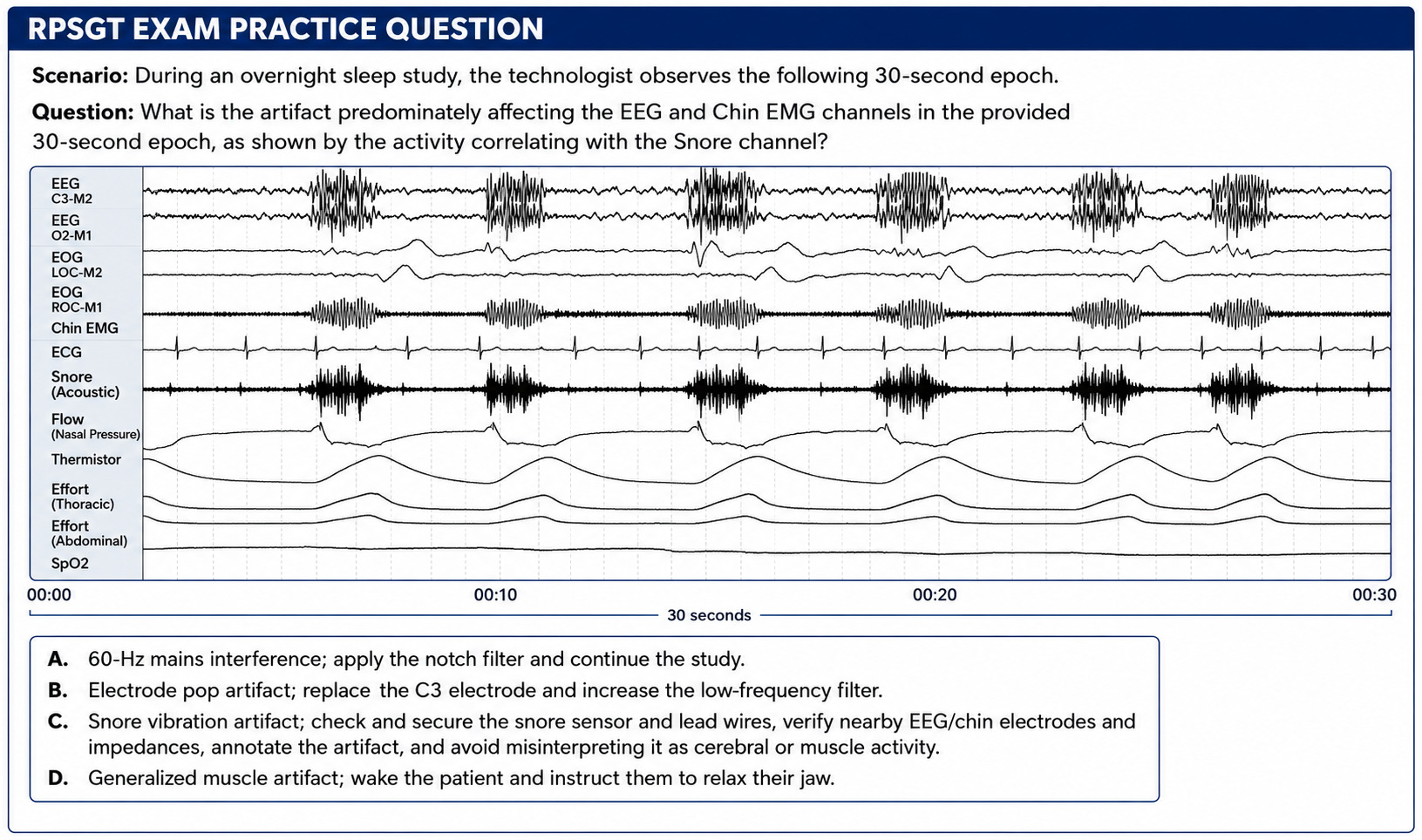
Educational PSG-style example: EEG and chin EMG bursts correlate with the snore channel.
Question: What is the artifact predominantly affecting the EEG and chin EMG channels, as shown by the activity correlating with the snore channel?
A. 60-Hz mains interference; apply the notch filter and continue the study.
B. Electrode pop artifact; replace the C3 electrode and increase the low-frequency filter.
C. Snore vibration artifact; check and secure the snore sensor and lead wires, verify nearby EEG/chin electrodes and impedances, annotate the artifact, and avoid misinterpreting it as cerebral or muscle activity.
D. Generalized muscle artifact; wake the patient and instruct them to relax their jaw.
Correct Answer: C. Snore Vibration Artifact
The strongest clue is channel correlation. The artifact in the EEG and chin EMG channels occurs at the same time as the snore-channel activity. This suggests that vibration from snoring is being transmitted into nearby electrodes, wires, or sensors.
In other words, this is not primarily a brain-wave finding, and it should not automatically be scored as true EEG or chin EMG activity. The technologist should recognize the pattern, troubleshoot the patient-side setup, and document the artifact clearly.
Best Technologist Response
- Confirm that the artifact is time-locked with snore activity.
- Check the snore microphone or piezo sensor placement.
- Secure the snore sensor and reduce cable movement.
- Separate or stabilize nearby wires if vibration is being transmitted.
- Check EEG and chin EMG electrodes for looseness or poor contact.
- Recheck impedances if the artifact is affecting scoring quality.
- Annotate the artifact in the study record.
- Avoid unnecessary filter changes unless there is a separate electrical problem.
Why the Other Answers Are Incorrect
A. 60-Hz Mains Interference
Mains interference is usually more continuous and electrical-looking. It does not typically appear only in bursts that line up with snoring.
B. Electrode Pop Artifact
Electrode pop is usually sudden, sharp, and often localized to a specific electrode or derivation. In this example, the activity is repetitive and tied to the snore channel.
D. Generalized Muscle Artifact
Muscle artifact can contaminate EEG and chin EMG, but the major clue here is that the activity correlates with the snore channel. The snore channel is telling the technologist where to look.
“Do not chase the EEG first when the snore channel is shouting the answer. If the bursts line up with snoring, think vibration, wires, sensor placement, and documentation.”
RPSGT Exam Connection
This question fits well under RPSGT Domain 2: Sleep Study Preparation and Performance, especially the task area involving artifact recognition, equipment troubleshooting, settings, calibrations, and impedance verification.
References and Resources
- BRPT RPSGT Exam Blueprint
- BRPT RPSGT Candidate Handbook
- AASM Manual for the Scoring of Sleep and Associated Events