Coach Bob Teaches: Stage N2 Sleep
A mini lesson for recognizing sleep spindles, K-complexes, theta-dominant background activity, and the scoring traps that make N2 questions tricky.
Download / Study Visual
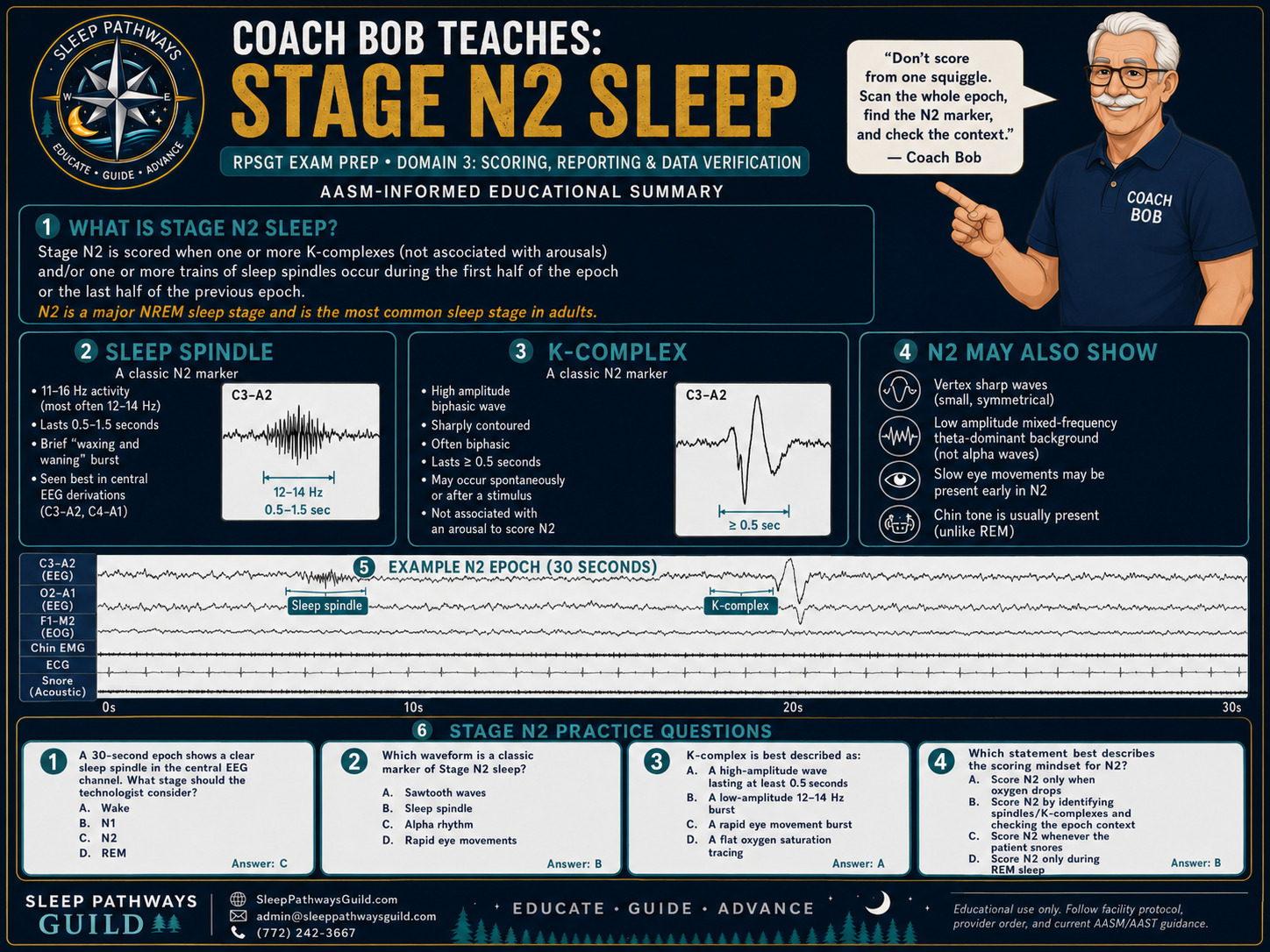
Use this visual as the quick study guide for today’s lesson. It focuses only on Stage N2 sleep: sleep spindles, K-complexes, low-amplitude mixed-frequency theta-dominant background, and one-best-option scoring practice.
Mini Lesson: What Is Stage N2 Sleep?
Stage N2 is a non-REM sleep stage. For scoring practice, the two classic N2 markers are sleep spindles and K-complexes. When you are reviewing a 30-second epoch, your job is not just to spot a waveform. Your job is to decide whether that waveform fits the scoring context.
Sleep Spindle
A sleep spindle is a brief burst of EEG activity. For RPSGT studying, remember:
- Frequency range: about 11–16 Hz
- Most commonly: 12–14 Hz
- Duration: at least about 0.5 seconds
- Often seen best in central EEG derivations
- Shape: a brief waxing-and-waning burst
K-Complex
A K-complex is another classic N2 marker. For exam practice, remember:
- High-amplitude waveform
- Often biphasic
- Sharply contoured
- Lasts at least 0.5 seconds
- Can occur spontaneously or after a stimulus
- For N2 scoring, watch whether it is associated with an arousal
Bonus Word of the Day: Micrognathia
Micrognathia means a smaller-than-normal lower jaw, or mandible. In sleep medicine, a small or recessed jaw can contribute to upper-airway narrowing and may increase concern for obstructive sleep-disordered breathing.
Bonus Word Practice Question
Which condition describes a smaller lower jaw that may increase upper-airway narrowing?
Reveal answer
Correct answer: B. Micrognathia.
Why: Micrognathia refers to a small lower jaw. In sleep medicine, jaw anatomy can affect upper-airway size and obstruction risk.
Stage N2 Practice Questions
Question 1
A 30-second epoch shows a clear sleep spindle in a central EEG channel. What stage should the technologist consider first?
Reveal answer
Correct answer: C. N2.
Why: A sleep spindle is a classic marker of Stage N2 sleep. The technologist should still check the rest of the epoch and scoring context.
Question 2
Which waveform is a classic marker of Stage N2 sleep?
Reveal answer
Correct answer: B. Sleep spindle.
Why: Sleep spindles and K-complexes are the classic N2 markers. Sawtooth waves and rapid eye movements point more toward REM context, while alpha rhythm is more associated with relaxed wakefulness.
Question 3
Which description best matches a K-complex?
Reveal answer
Correct answer: A. A high-amplitude, often biphasic waveform lasting at least 0.5 seconds.
Why: A K-complex is a high-amplitude waveform and is a classic N2 marker when it fits the scoring context.
Question 4
Which EEG background description best fits Stage N2 sleep?
Reveal answer
Correct answer: B. Low-amplitude mixed-frequency activity with theta-dominant background.
Why: N2 is not described as alpha-dominant. The background is generally lower-amplitude mixed-frequency sleep EEG, often theta-dominant, with N2 markers such as spindles and/or K-complexes.
Question 5
An epoch has low chin tone and rapid eye movements, but no sleep spindles or K-complexes. Which response best reflects the scoring mindset?
Reveal answer
Correct answer: B. Check for REM context rather than assuming N2.
Why: Rapid eye movements with low chin tone are important REM clues. N2 scoring requires the correct context and N2 markers such as spindles or K-complexes.
Question 6
Which statement best describes the RPSGT scoring mindset for N2?
Reveal answer
Correct answer: B. Score N2 by identifying N2 markers and checking the full epoch context.
Why: RPSGT-style scoring questions reward rule-based pattern recognition, not guessing from one channel or one symptom.
Reveal Flashcards: Practice Before You Look
Write your answer first. Then open the card to check yourself.
Card 1 Front: What are the two classic N2 markers?
Card 2 Front: What does a sleep spindle look like?
Card 3 Front: What does a K-complex look like?
Card 4 Front: What background EEG should you think of for N2?
Card 5 Front: What is the N2 scoring trap?
Card 6 Front: What does micrognathia mean?
Glossary Terms
Free Review Resources
These are free learner-facing resources. Paid references are listed below without links.
Paid / Restricted References Listed Only
American Academy of Sleep Medicine. (2025). The AASM manual for the scoring of sleep and associated events: Rules, terminology and technical specifications (Version 3). American Academy of Sleep Medicine.
American Academy of Sleep Medicine. (2023). International classification of sleep disorders (3rd ed., text rev.). American Academy of Sleep Medicine.
Chiong, T. L., Mattice, C., & Brooks, R. (2019). Fundamentals of sleep technology (3rd ed.). Wolters Kluwer.
Linked references & resources
Official sources are prioritized. Book links open Amazon search results so readers can compare available editions.
Affiliate disclosure: As an Amazon Associate I earn from qualifying purchases. Book links marked “paid link” may generate a commission at no additional cost to you.
- Fundamentals of Sleep Technology — view available editions on Amazon (paid link)
Verify the title, author, and edition before purchasing. - AASM Scoring Manual — official page
Use the current version followed by your facility. - International Classification of Sleep Disorders — official AASM page
Official source for current edition information.