
RPSGT Exam Practice: Troubleshooting Tricky Areas
Practice one-best-option thinking for the BRPT RPSGT exam using real sleep lab style scenarios: patient safety, ECG artifact, PAP leak, HSAT setup, EEG artifact, PSG scoring, report verification, and upper-airway anatomy.
Free Download Visual
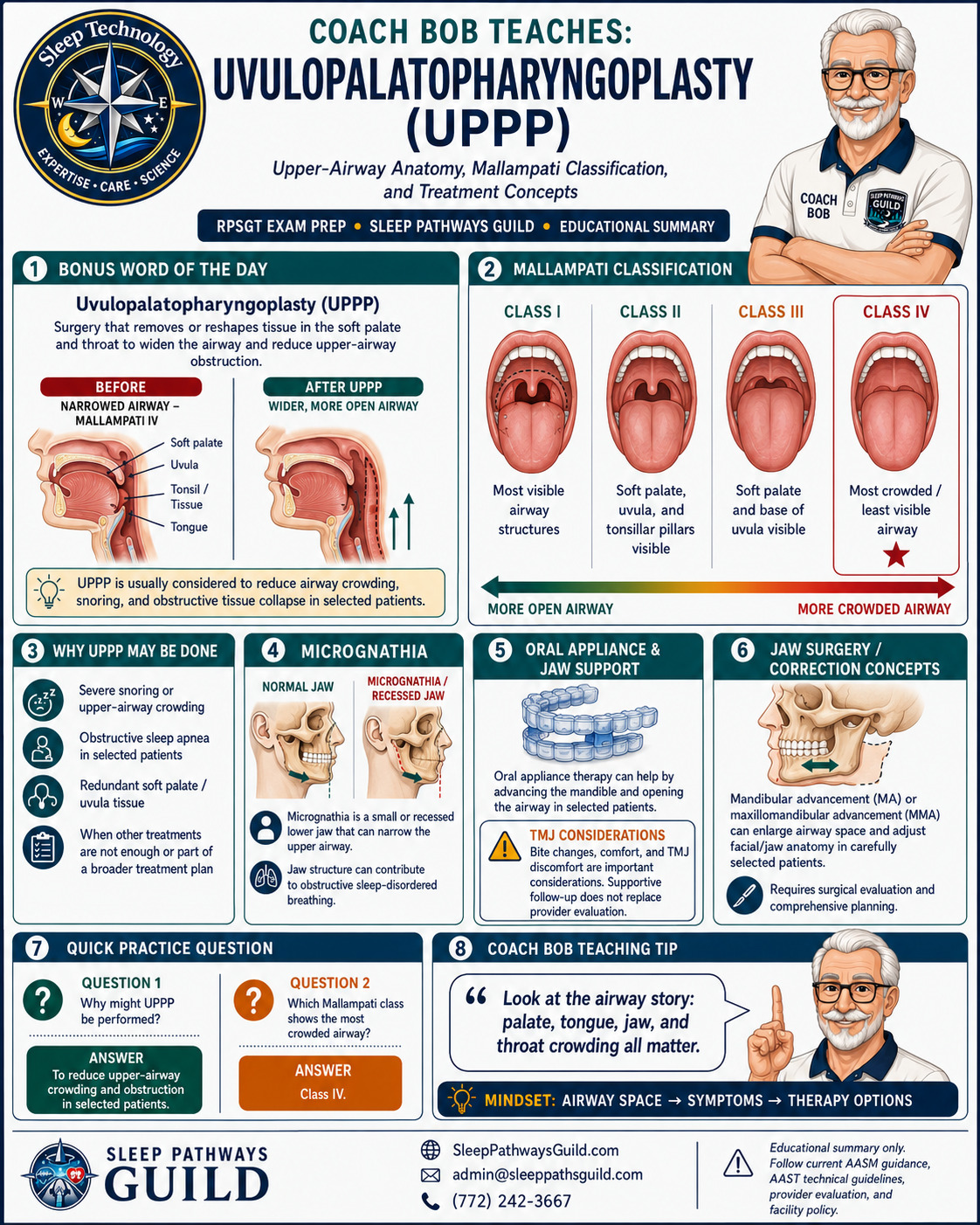
Use today’s visual to review UPPP, Mallampati classification, micrognathia, oral appliance therapy, TMJ considerations, and jaw surgery concepts. These topics help connect upper-airway anatomy with obstructive sleep apnea treatment history and RPSGT exam reasoning.
Mini Lesson: How to Study for RPSGT Scenario Questions
RPSGT scenario questions test more than memorization. They ask whether a sleep technologist can apply clinical judgment, technical troubleshooting, patient safety, PSG scoring logic, PAP therapy support, patient education, and documentation standards in the moment.
When a question asks for the BEST answer, more than one option may sound possible. Your job is to select the choice that is safest, most technically correct, and most aligned with sleep lab practice.
Ask Yourself
- Is this a patient safety problem?
- Is this a signal quality problem?
- Is this a PAP troubleshooting problem?
- Is this a scoring or report verification problem?
- Is this asking for recommended practice, not local habit?
Tricky Areas
- Artifact recognition
- Cardiac event recognition
- HSAT setup and education
- PAP leak troubleshooting
- Sleep staging waveform recognition
- Report verification and documentation
Bonus Word of the Day: Uvulopalatopharyngoplasty (UPPP)
Uvulopalatopharyngoplasty, often shortened to UPPP, is a surgical procedure that removes or reshapes tissue in the soft palate, uvula, and pharyngeal area to help widen the upper airway in selected patients with obstructive sleep apnea.
Why UPPP May Be Done
- To reduce upper-airway crowding in selected patients
- To remove or reshape redundant soft palate or uvular tissue
- To address obstruction in the oropharyngeal airway
- Often considered when conservative therapy is not enough or as part of a broader treatment plan
Technologist Scope
- Recognize the term in the medical history
- Document prior airway surgery accurately
- Understand that anatomy can affect PAP tolerance and airway patency
- Do not diagnose, prescribe, recommend surgery, or determine surgical candidacy
Free Mini Lesson: Airway Anatomy and Treatment Clues
RPSGT exam questions may connect symptoms, anatomy, treatment history, and sleep study findings. A patient with obstructive sleep apnea may have upper-airway crowding, a high Mallampati class, micrognathia, prior airway surgery, or use of an oral appliance. The sleep technologist should recognize these terms and document them clearly.
Mallampati Classification
The Mallampati classification is a visual airway assessment based on what structures can be seen in the mouth when the patient opens wide and protrudes the tongue.
- Class I: Most airway structures visible
- Class II: Soft palate, uvula, and pillars partly visible
- Class III: Soft palate and base of uvula visible
- Class IV: Most crowded airway; only hard palate may be visible
Micrognathia
Micrognathia means a smaller-than-normal lower jaw, or mandible. A small or recessed jaw can reduce upper-airway space and may contribute to obstructive sleep-disordered breathing risk.
Oral Appliance Therapy
Oral appliance therapy often uses a custom mandibular advancement device to move the lower jaw forward during sleep. This may help keep the upper airway more open in selected patients.
Jaw Surgery Concepts
Some patients with significant jaw-related airway narrowing may be evaluated for surgical correction, such as mandibular advancement or maxillomandibular advancement. These procedures move jaw structures forward to enlarge airway space.
25 RPSGT Practice Questions
Answer first. Then open the reveal box to check your reasoning.
Question 1: Possible Life-Threatening ECG Pattern or Artifact?
During PSG, the ECG tracing suddenly becomes chaotic. You cannot identify consistent QRS complexes. You call over the intercom, but the patient does not respond. What is the BEST response?
Reveal answer
Correct answer: B.
Patient safety comes first. The intercom does not prove the patient is okay. The patient may be asleep, hard of hearing, wearing PAP, or unable to respond. Assess the patient and verify the signal before assuming artifact.
Question 2: PAP Leak During Titration
Leak rises sharply, airflow becomes distorted, and snoring returns after a pressure increase. What is the BEST next step?
Reveal answer
Correct answer: C.
Large leak can make treatment data unreliable. Fix the leak before chasing pressure.
Question 3: HSAT Patient Education
A patient says they watched an online video and do not need HSAT instructions. What is the BEST response?
Reveal answer
Correct answer: B.
Good education helps prevent failed or poor-quality studies. The patient should understand setup, sensor placement, and what to do if a sensor comes loose.
Question 4: Snoring Artifact
EEG shows high-amplitude irregular activity that matches bursts in the chin EMG and snore channel. What is the BEST interpretation?
Reveal answer
Correct answer: A.
Artifact should be correlated across channels before scoring or escalating.
Question 5: Report Verification
The report shows a sleep efficiency value that does not match total sleep time and recording time. What should the technologist do?
Reveal answer
Correct answer: C.
Verify before finalizing or forwarding a report. Computer-generated reports can still contain errors.
Question 6: UPPP Meaning
A patient history lists UPPP. What does this refer to?
Reveal answer
Correct answer: B.
UPPP stands for uvulopalatopharyngoplasty.
Question 7: Why UPPP May Be Done
Why might UPPP appear in the history of a patient with OSA?
Reveal answer
Correct answer: A.
UPPP is an upper-airway surgery intended to reduce selected areas of obstruction.
Question 8: Mallampati IV
Which Mallampati class suggests the most crowded oral airway?
Reveal answer
Correct answer: D.
Class IV is the most crowded airway view and has the fewest visible oral airway structures.
Question 9: Micrognathia
A pediatric patient is noted to have a small recessed lower jaw. Which term best describes this finding?
Reveal answer
Correct answer: A.
Micrognathia means a small or recessed lower jaw.
Question 10: Oral Appliance Therapy
What is the usual purpose of a mandibular advancement oral appliance?
Reveal answer
Correct answer: A.
Mandibular advancement may help open the upper airway in selected patients.
Question 11: TMJ Considerations
A patient using an oral appliance reports jaw soreness. What is the BEST technologist response?
Reveal answer
Correct answer: B.
TMJ symptoms and jaw comfort should be documented and addressed through appropriate provider follow-up.
Question 12: Technologist Scope
A patient asks whether they should get UPPP. What is the BEST response?
Reveal answer
Correct answer: B.
Stay within scope. The technologist may educate generally and direct provider-specific questions to the provider.
Question 13: PAP Tolerance and Anatomy
A patient has upper-airway crowding and trouble tolerating PAP. What should the technologist do?
Reveal answer
Correct answer: A.
The technologist supports ordered therapy, documents barriers, and follows procedure.
Question 14: ECG Lead Loose
The ECG signal is intermittent and worsens with patient movement. What is the BEST action?
Reveal answer
Correct answer: A.
Signal problems require equipment and electrode troubleshooting.
Question 15: HSAT Failed Signal
What is a common way to reduce HSAT failure?
Reveal answer
Correct answer: A.
Patient education is central to HSAT quality.
Question 16: Report Discrepancy
The hypnogram and sleep stage totals do not match. What should be done?
Reveal answer
Correct answer: A.
Report quality depends on verification of data and calculations.
Question 17: Sleep Stage Clue
A clear sleep spindle appears in a central EEG derivation. Which stage should be considered in context?
Reveal answer
Correct answer: C.
Sleep spindles are classic N2 markers when the epoch context fits.
Question 18: Oxygen Safety
A patient asks the technologist to increase oxygen above the ordered protocol. What is the BEST response?
Reveal answer
Correct answer: B.
Oxygen changes must follow order, policy, and appropriate documentation.
Question 19: Mask Discomfort
A patient reports pressure on the bridge of the nose from the mask. What is the BEST action?
Reveal answer
Correct answer: A.
Comfort issues can affect adherence and data quality.
Question 20: Arousal and Artifact
A sudden EEG frequency shift occurs with movement artifact. What should the scorer do?
Reveal answer
Correct answer: A.
Scoring requires signal quality review and rule-based interpretation.
Question 21: High Mallampati Finding
A patient has a Mallampati IV airway documented in history. What does this suggest?
Reveal answer
Correct answer: A.
Mallampati IV suggests a crowded airway view.
Question 22: Jaw Surgery History
A history lists maxillomandibular advancement. What should the technologist understand?
Reveal answer
Correct answer: A.
MMA moves jaw structures forward to increase airway space in selected cases.
Question 23: Best-Answer Strategy
Which choice best describes one-best-option thinking?
Reveal answer
Correct answer: B.
RPSGT scenarios reward safe, guideline-aligned, within-scope decisions.
Question 24: Documentation
Which documentation is most appropriate after troubleshooting PAP leak?
Reveal answer
Correct answer: A.
Clear documentation tells the story of the study and response to intervention.
Question 25: Airway Story
A patient has loud snoring, Mallampati IV, micrognathia, and oral appliance history. What is the BEST technologist mindset?
Reveal answer
Correct answer: A.
The technologist connects history and observations while staying within scope.
Reveal Flashcards
Try to answer before opening each card.
Card 1: What comes first in a possible emergency?
Card 2: What should you do before increasing PAP pressure when leak is high?
Card 3: Why does HSAT education matter?
Card 4: What is the artifact rule?
Card 5: What is report verification?
Card 6: What does UPPP mean?
Card 7: What does Mallampati IV suggest?
Card 8: What is micrognathia?
Card 9: What does an oral appliance often do?
Card 10: What is the technologist’s airway-anatomy role?
Glossary Terms
Free Review Resources
Use these free resources to continue your RPSGT exam prep and learn how to study for the RPSGT exam using the official blueprint, practice guidance, and technical review.
Paid / Restricted References Listed Only
American Academy of Sleep Medicine. The AASM manual for the scoring of sleep and associated events: Rules, terminology and technical specifications. American Academy of Sleep Medicine.
American Academy of Sleep Medicine. International classification of sleep disorders (3rd ed., text rev.). American Academy of Sleep Medicine.
Chiong, T. L., Mattice, C., & Brooks, R. Fundamentals of sleep technology (3rd ed.). Wolters Kluwer.
Coach Bob Closing Study Tip
When studying RPSGT practice questions, do not only memorize the answer. Ask why the best answer is safest, most technically correct, most aligned with the blueprint task, and most appropriate for the sleep technologist’s scope.
Linked references & resources
Official sources are prioritized. Book links open Amazon search results so readers can compare available editions.
Affiliate disclosure: As an Amazon Associate I earn from qualifying purchases. Book links marked “paid link” may generate a commission at no additional cost to you.
- Fundamentals of Sleep Technology — view available editions on Amazon (paid link)
Verify the title, author, and edition before purchasing. - AASM Scoring Manual — official page
Use the current version followed by your facility. - International Classification of Sleep Disorders — official AASM page
Official source for current edition information.