
RPSGT Study Lesson
Domain 3
Artifact Recognition
Domain 3 Study: Recognizing EKG Artifact During a Sleep Study
EKG artifact can fool even experienced sleep technologists.
In today’s Sleep Pathways Guild Domain 3 study focus, we are looking at one of the most important technical skills in polysomnography: recognizing artifact before mistaking it for pathology.
The First Question to Ask
When a sharp waveform appears in the EEG, EOG, or leg channels, the first question should be:
Does it line up with the ECG?
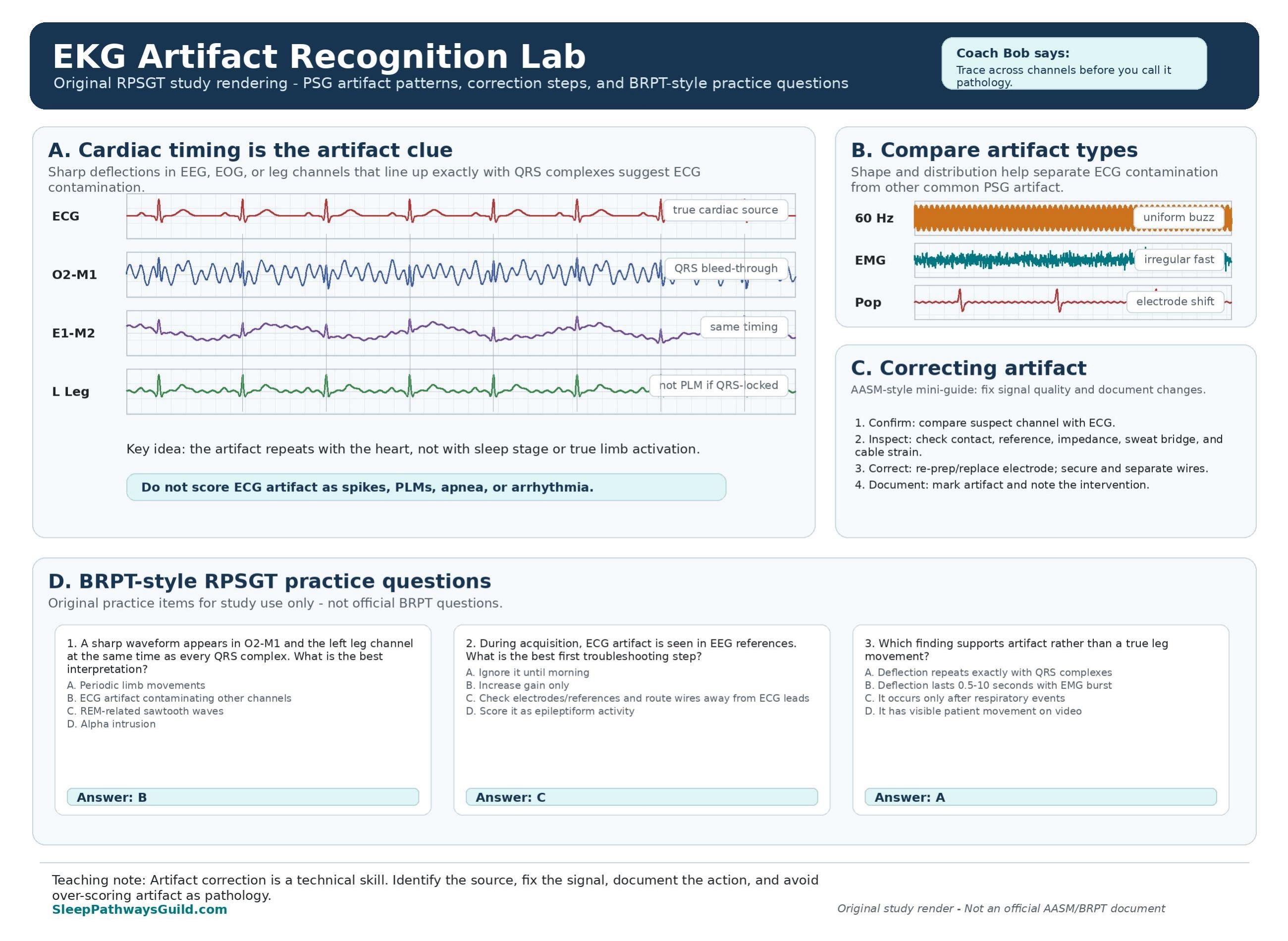
If the deflection repeats at the exact same time as the QRS complex, it may be ECG artifact bleeding into another channel.
This matters because artifact can be mistaken for abnormal EEG activity, eye movement, periodic limb movement, respiratory-related movement, or even arrhythmia.
Study Visual: EKG Artifact Recognition Lab
Use the study visual below to practice tracing across channels and comparing suspicious waveforms with the ECG channel.
Open the EKG Artifact Study Visual
What this visual teaches:
ECG artifact can appear in EEG channels.
ECG artifact can appear in EOG channels.
ECG artifact can appear in leg channels.
Timing is the clue.
Artifact should not be scored as pathology.
Coach Bob Study Tip
Trace across channels before you call it abnormal.
If the same sharp wave repeats with every QRS complex, think artifact first. Compare the suspicious channel to the ECG channel, then check electrode placement, wire routing, reference electrodes, impedance, sweat bridges, and cable strain.
Why This Matters for RPSGT Preparation
RPSGT-style questions often test whether the sleep technologist can recognize what is real and what is artifact. In the sleep lab, this skill protects the quality of the study and helps prevent over-scoring.
A clean study is not just about placing sensors. It is about watching the signals, recognizing problems, correcting artifact, and documenting what was done.
Mini Review: How to Correct Suspected EKG Artifact
1. Confirm
Compare the suspicious waveform with the ECG channel.
2. Inspect
Check electrode contact, impedance, references, sweat bridges, cable tension, and wire placement.
3. Correct
Re-prep or replace electrodes when needed. Secure wires and separate ECG leads from EEG, EOG, and EMG wires when possible.
4. Document
Mark artifact and document technical interventions according to lab policy.
Practice Question
A sharp waveform appears in O2-M1 and the left leg channel at the same time as every QRS complex. What is the best interpretation?
Topic: Artifact recognition and ECG contamination
A. Periodic limb movements
B. ECG artifact contaminating other channels
C. REM-related sawtooth waves
D. Alpha intrusion
Reveal answer
The key clue is that the waveform repeats with the QRS complex.
Bonus Sleep Science Pearl: Zeitgebers, or “Time-Givers”
The word is spelled zeitgebers. A zeitgeber is an outside cue that helps set or synchronize the body’s internal clock. In simple sleep-tech language, zeitgebers are the signals that tell the brain and body what time it is.
Common Zeitgebers
Light, darkness, meal timing, activity, social routines, work schedules, school schedules, caffeine timing, screen exposure, and bedtime routines can all act as timing cues.
Example: The Night-Shift Sleep Technologist
A sleep technologist finishes a night shift at 7:00 AM and walks outside into bright morning sunlight. The tech is exhausted and wants to sleep, but the bright light is sending a strong “daytime” signal to the brain. Then the tech drives home, eats breakfast, scrolls on a bright phone, and tries to sleep in a room with daylight leaking through the windows.
In this example, the body is getting mixed messages:
Tells the brain it is daytime and time to be alert.
Can reinforce the body’s daytime rhythm.
Adds more alerting light exposure before sleep.
Makes daytime sleep harder to protect.
Coach Bob Zeitgeber Tip
Protect your sleep window like it is a study signal. If light is telling your brain “wake up,” but your schedule says “sleep now,” your circadian rhythm may fight you.
How the Tech Could Use Zeitgebers Better
After a night shift, the tech may protect daytime sleep by reducing bright light exposure on the commute home, keeping the bedroom dark and cool, using a consistent sleep schedule when possible, avoiding bright screens before sleep, and keeping meals and caffeine timed in a way that supports the intended sleep window.
This matters for sleep technology because patients may also arrive with circadian timing problems. Shift work, delayed sleep schedules, inconsistent wake times, late caffeine, light exposure, and irregular routines can affect sleep timing, sleep latency, REM timing, and how a sleep study looks.
Disclosure
This post and study visual are original Sleep Pathways Guild educational materials. They are designed for study support, sleep technology education, and RPSGT exam preparation.
They are not official AASM, BRPT, or exam-board documents. The practice question is written in an RPSGT-style educational format and is not an official BRPT exam question.
Always follow your sleep center policy, medical director guidance, manufacturer instructions, and the current AASM scoring manual.
Educational References
American Academy of Sleep Medicine. The AASM Manual for the Scoring of Sleep and Associated Events.
Fundamentals of Sleep Technology.
Sleep Technician Guide / Sleep Technician educational materials.
Polysomnography artifact recognition and technical troubleshooting references used for topic development.
Circadian rhythm and zeitgeber educational references used for bonus topic development.
Free RPSGT study tools and sleep technology education: SleepPathwaysGuild.com
Linked references & resources
Official sources are prioritized. Book links open Amazon search results so readers can compare available editions.
Affiliate disclosure: As an Amazon Associate I earn from qualifying purchases. Book links marked “paid link” may generate a commission at no additional cost to you.
- Fundamentals of Sleep Technology — view available editions on Amazon (paid link)
Verify the title, author, and edition before purchasing. - AASM Scoring Manual — official page
Use the current version followed by your facility.