RPSGT Study Lesson
Domain 3
Scoring + Reporting
Artifact Recognition
RPSGT Domain 3 Study: Scoring, Reporting, Data Verification, and EKG Artifact Recognition
Today’s Sleep Pathways Guild study lesson focuses on RPSGT Domain 3: Scoring, Reporting, and Data Verification.
Domain 3 is one of the most important areas for RPSGT preparation because it tests whether the sleep technologist can apply scoring rules, recognize true physiologic events, avoid artifact traps, and verify that the final report makes sense.
This lesson includes adult scoring, pediatric and infant scoring, report math, data verification, artifact recognition, EKG artifact recognition, and a bonus sleep science pearl on zeitgebers.
How to Think Like a Sleep Technologist in Domain 3
When reviewing a sleep study, the sleep technologist should always be thinking:
Domain 3 Task Breakdown
Domain 3: Scoring, Reporting, and Data Verification
RPSGT Blueprint Weight: 25.3%
Task A: Score Adult Studies
Adult scoring includes sleep stages, arousals, respiratory events, oxygen desaturations, movements, and cardiac events.
Key topics include Wake, N1, N2, N3, REM, alpha rhythm, theta rhythm, sleep spindles, K-complexes, slow-wave activity, arousals, apneas, hypopneas, RERAs, PLMs, desaturations, Cheyne-Stokes breathing, hypoventilation, cardiac events, and artifact recognition.
Task B: Score Pediatric and Infant Studies
Pediatric and infant scoring includes sleep staging, arousals, respiratory events, desaturations, movements, and cardiac events.
Pediatric scoring requires special attention because children are not just “small adults.” Pediatric respiratory scoring may use breath-based rules, and CO₂ monitoring may be important when evaluating hypoventilation.
Task C: Generate and Verify Report
Report generation and verification includes calculations, technologist documentation summaries, and graphic summaries.
Important report topics include AHI, RDI, TST, REI, sleep efficiency, sleep latency, REM latency, WASO, sleep period time, PLM index, PLM arousal index, REM AHI, supine AHI, hypnogram review, histogram review, titration tables, and technologist notes.
Practice Set Breakdown
Adult scoring questions
Pediatric and infant scoring questions
Report math and data verification questions
25 practice questions
These questions are adapted from the Sleep Pathways Guild internal RPSGT question-bank inventory and edited for public educational review.
Domain 3 Memory Tool: REAL SCORE
Recognize the channel and signal source.
Evaluate signal quality before scoring.
Apply adult or pediatric criteria correctly.
Look for required duration and consequence criteria.
Score only what meets criteria, then verify the report.
Domain 3 rewards careful scorers. One missed rule can change an index, a diagnosis impression, or the way a study is understood.
Domain 3 Scoring Decision Path
Before deciding what to score, walk through this sequence:
EEG, EOG, chin EMG, leg EMG, airflow, effort, SpO₂, snore, CO₂, or ECG?
Is it clean enough to score, or is there artifact?
Does the event meet minimum duration criteria?
Does it require arousal, desaturation, awakening, or another physiologic change?
Adult and pediatric criteria may differ.
Do the final indices match the scored data?
Study Tracker
Check these off as you review.
25 Practice Questions With Click-to-Reveal Answers
1. Which of the following is required to score N3 sleep?
Topic: Sleep Staging
A. Sleep spindles
B. K-complexes
C. Delta waves ≥10% of the epoch
D. Delta waves ≥20% of the epoch
Reveal answer
Rationale: N3 requires slow-wave activity in at least 20% of the epoch.
2. During N2 sleep, a K-complex is followed by a brief burst of faster EEG activity lasting 2 seconds. How should this be scored?
Topic: Arousal Scoring
A. Normal N2 variability
B. Arousal present
C. Movement artifact
D. Transition to N1
Reveal answer
Rationale: A scored arousal requires an EEG frequency shift lasting at least 3 seconds, so a 2-second shift does not meet criteria.
3. Arousals in NREM sleep require which EEG change?
Topic: Arousal Scoring
A. K-complex
B. Alpha or faster activity lasting at least 3 seconds
C. Sleep spindle
D. Delta burst
Reveal answer
Rationale: NREM arousals require an abrupt EEG frequency shift lasting at least 3 seconds.
4. For scoring an arousal in REM sleep, the EEG frequency shift must last at least 3 seconds and be accompanied by:
Topic: REM Arousal Scoring
A. A concurrent increase in submental EMG tone lasting at least 1 second
B. A 3% oxygen desaturation
C. An increase in heart rate
D. An awakening
Reveal answer
Rationale: REM arousals require the EEG shift plus a concurrent chin EMG increase.
5. Before an arousal can be scored, there must be at least how much stable sleep immediately before it?
Topic: Arousal Scoring
A. 3 seconds
B. 5 seconds
C. 10 seconds
D. 15 seconds
Reveal answer
Rationale: Arousal scoring requires at least 10 seconds of stable sleep before the event.
6. Which EEG frequency range defines theta activity?
Topic: EEG Fundamentals
A. 0.5–2 Hz
B. 4–7 Hz
C. 8–13 Hz
D. 13–30 Hz
Reveal answer
Rationale: Theta activity is commonly associated with drowsiness and N1 sleep.
7. Which frequency range defines posterior dominant rhythm, also known as alpha rhythm, in a healthy adult?
Topic: EEG Fundamentals
A. 4–7 Hz
B. 14–30 Hz
C. 8–13 Hz
D. 0.5–2 Hz
Reveal answer
Rationale: Posterior dominant rhythm is an important wakefulness marker.
8. Which of the following is a primary characteristic of Stage N1 sleep?
Topic: Sleep Staging
A. K-complexes
B. Slow rolling eye movements
C. Sleep spindles
D. Sawtooth waves
Reveal answer
Rationale: Slow rolling eye movements are classic for N1, while K-complexes and spindles support N2.
9. During N2 sleep, a spindle appears immediately after a K-complex. What stage should be scored?
Topic: Sleep Staging
A. N1
B. N2
C. N3
D. REM
Reveal answer
Rationale: Sleep spindles and K-complexes are classic N2 markers.
10. An epoch contains 18% slow-wave activity and a clear sleep spindle. How should it be scored?
Topic: Sleep Staging
A. N1
B. N2
C. N3
D. REM
Reveal answer
Rationale: Slow-wave activity does not reach the 20% threshold for N3, and the spindle supports N2.
11. A patient’s airflow signal shows flattening but no desaturation or arousal. What is this most consistent with?
Topic: Respiratory Events
A. Hypopnea
B. Obstructive apnea
C. Flow limitation without a scored event
D. RERA
Reveal answer
Rationale: Flattening alone suggests flow limitation, but without a qualifying arousal or desaturation, it may not meet criteria for a scored event.
12. A patient shows repeated arousals associated with increasing respiratory effort but no desaturation. What event should be scored?
Topic: Respiratory Events
A. No event
B. RERA
C. Hypopnea
D. Central apnea
Reveal answer
Rationale: Increasing respiratory effort leading to an arousal without meeting apnea or hypopnea criteria is most consistent with a respiratory effort-related arousal.
13. A patient shows airflow reduction of 35% with a 3% desaturation. What should be scored?
Topic: Hypopnea Scoring
A. RERA
B. Hypopnea
C. Central apnea
D. Obstructive apnea
Reveal answer
Rationale: A reduction in airflow with a qualifying desaturation can meet adult hypopnea criteria.
14. Which signal is most sensitive for detecting flow limitation?
Topic: Respiratory Signals
A. Thermistor
B. Nasal pressure
C. Snore microphone
D. End-tidal CO₂
Reveal answer
Rationale: Nasal pressure is a sensitive commonly used PSG signal for inspiratory flow limitation.
15. Which sensor is recommended for scoring apneas?
Topic: Respiratory Signals
A. Oronasal thermal airflow sensor
B. Nasal pressure transducer
C. End-tidal PCO₂
D. RIP belts
Reveal answer
Rationale: Thermal airflow sensors are commonly used for apnea detection.
16. Which respiratory pattern is most consistent with Cheyne-Stokes respiration?
Topic: Respiratory Patterns
A. Irregular breathing with mixed apneas
B. Crescendo-decrescendo pattern with central apneas
C. Waxing and waning airflow with obstructive apneas
D. Periodic breathing without apneas
Reveal answer
Rationale: Cheyne-Stokes respiration features a crescendo-decrescendo breathing pattern linked with central events.
17. The presence of paradoxical breathing, with chest and abdomen moving opposite each other, is typically an indicator of:
Topic: Respiratory Events
A. Central sleep apnea
B. Upper airway resistance or obstruction
C. Normal physiological sleep
D. Hypoventilation
Reveal answer
Rationale: Paradoxical breathing suggests increased effort against an obstructed or resistant upper airway.
18. What is the minimum duration required to score a periodic limb movement?
Topic: Limb Movement Scoring
A. 0.1 seconds
B. 0.5 seconds
C. 1.5 seconds
D. 2.0 seconds
Reveal answer
Rationale: Limb movements must meet duration criteria before they can be counted.
19. To score a sequence of limb movements as PLMs, what is the minimum number of consecutive limb movements that must occur?
Topic: Limb Movement Scoring
A. 2
B. 3
C. 4
D. 5
Reveal answer
Rationale: PLMS require a sequence of at least four qualifying limb movements.
20. To be part of the same PLM sequence, the interval between movement onsets must be:
Topic: Limb Movement Scoring
A. 0.5 to 10 seconds
B. 5 to 90 seconds
C. 10 to 120 seconds
D. 20 to 180 seconds
Reveal answer
Rationale: PLM sequences require proper onset-to-onset spacing between movements.
21. According to pediatric scoring rules, a pediatric obstructive apnea is scored when the event lasts for at least:
Topic: Pediatric Respiratory Scoring
A. 10 seconds
B. 2 missed breaths
C. 5 seconds
D. 3 missed breaths
Reveal answer
Rationale: Pediatric respiratory scoring often uses breath-based criteria rather than only adult-style fixed time rules.
22. According to pediatric scoring rules, a pediatric hypopnea requires an amplitude drop of at least 30% plus an arousal, awakening, or oxygen desaturation of at least:
Topic: Pediatric Respiratory Scoring
A. 2%
B. 3%
C. 4%
D. 5%
Reveal answer
Rationale: Pediatric hypopnea criteria differ from adult scoring in important ways.
23. Which method is recommended for monitoring pediatric hypoventilation during sleep studies?
Topic: Pediatric Hypoventilation
A. Pulse oximetry only
B. End-tidal or transcutaneous PCO₂
C. RIP belts only
D. Thermistor only
Reveal answer
Rationale: Pediatric hypoventilation is monitored using end-tidal or transcutaneous CO₂ rather than oxygen saturation alone.
24. A patient slept for 360 minutes and had 120 apneas plus hypopneas. What is the AHI?
Topic: Report Math
A. 10
B. 15
C. 20
D. 30
Reveal answer
Rationale: AHI equals total apneas plus hypopneas divided by total sleep time in hours. 360 minutes equals 6 hours. 120 ÷ 6 = 20.
25. A study shows a mild overall AHI, but the patient had almost no REM sleep and very little supine sleep. What interpretation caution is most appropriate?
Topic: Report Interpretation
A. The study definitely overestimated severity
B. Severity may have been underestimated
C. REM and position are irrelevant
D. The patient does not have OSA
Reveal answer
Rationale: OSA can worsen in REM sleep and in the supine position. Limited REM or supine time may make the overall AHI look lower than usual.
Focused Domain 3 Pearl: Recognizing EKG Artifact During a Sleep Study
EKG artifact can fool even experienced sleep technologists. When a sharp waveform appears in the EEG, EOG, or leg channels, the first question should be:
Does it line up with the ECG?
If the deflection repeats at the exact same time as the QRS complex, it may be ECG artifact bleeding into another channel.
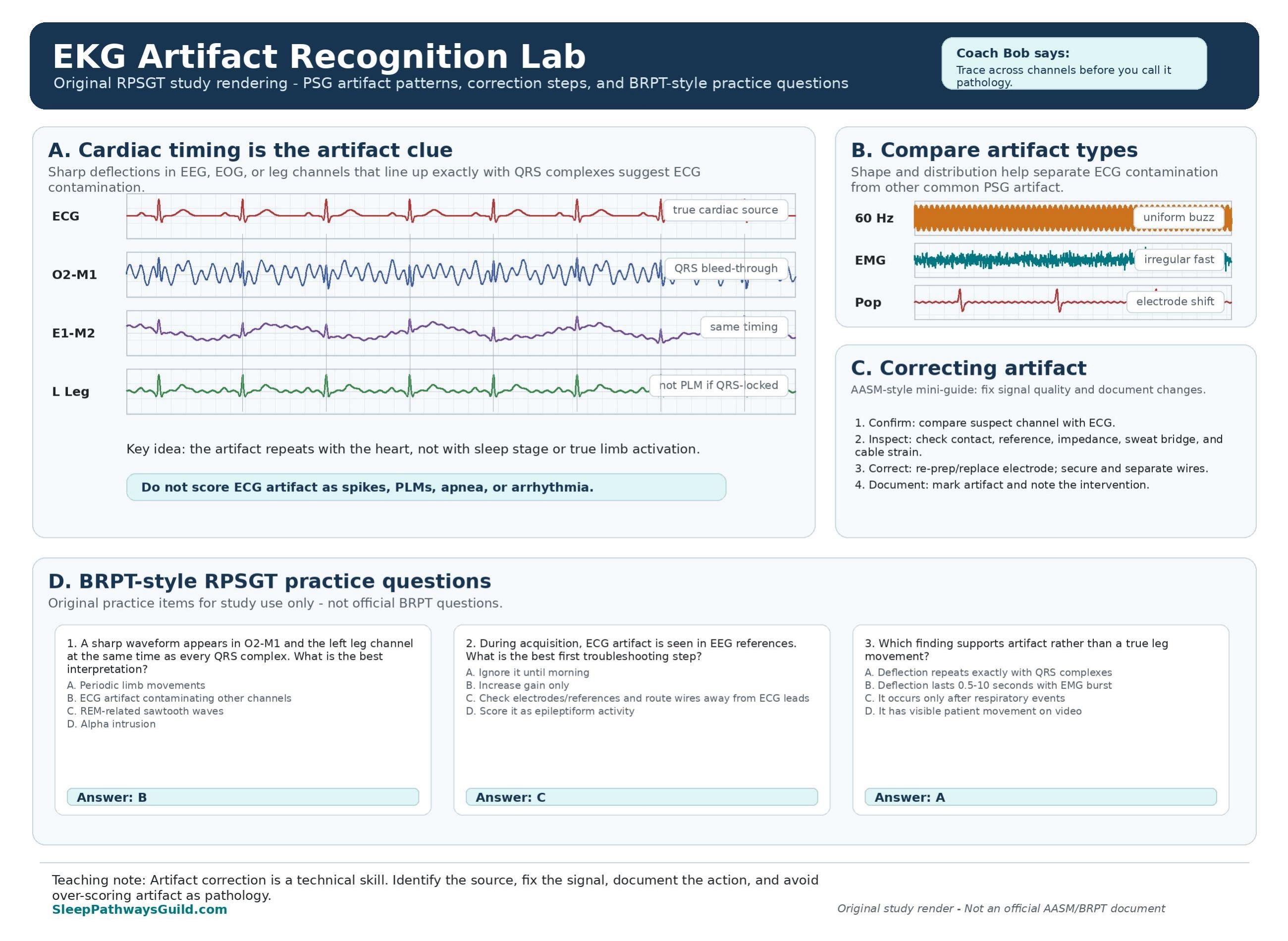
This matters because artifact can be mistaken for abnormal EEG activity, eye movement, periodic limb movement, respiratory-related movement, or even arrhythmia.
Study Visual: EKG Artifact Recognition Lab
Use the study visual below to practice tracing across channels and comparing suspicious waveforms with the ECG channel.
Open the EKG Artifact Study Visual
What this visual teaches:
ECG artifact can appear in EEG channels.
ECG artifact can appear in EOG channels.
ECG artifact can appear in leg channels.
Timing is the clue.
Artifact should not be scored as pathology.
Coach Bob Study Tip
Trace across channels before you call it abnormal. If the same sharp wave repeats with every QRS complex, think artifact first.
Mini Review: How to Correct Suspected EKG Artifact
1. Confirm
Compare the suspicious waveform with the ECG channel.
2. Inspect
Check electrode contact, impedance, references, sweat bridges, cable tension, and wire placement.
3. Correct
Re-prep or replace electrodes when needed. Secure wires and separate ECG leads from EEG, EOG, and EMG wires when possible.
4. Document
Mark artifact and document technical interventions according to lab policy.
10 Glossary Terms
1. Sleep staging
Classifying sleep into W, N1, N2, N3, and REM based on EEG, EOG, and EMG findings.
2. Arousal
An abrupt EEG frequency shift that meets scoring duration and sleep-context rules.
3. Hypopnea
A partial reduction in airflow that meets duration and consequence criteria.
4. Apnea
A marked reduction or absence of airflow meeting scoring rules.
5. RERA
Respiratory effort-related arousal; increasing respiratory effort leading to arousal without meeting apnea or hypopnea criteria.
6. Desaturation
A drop in oxygen saturation associated with respiratory or other physiologic events.
7. PLM
Periodic limb movement; a qualifying limb movement occurring in a sequence that meets timing criteria.
8. AHI
Apnea-Hypopnea Index; apneas plus hypopneas per hour of sleep.
9. Sleep efficiency
Total sleep time divided by time in bed, multiplied by 100.
10. Hypnogram
A graphic summary of sleep stages across the night.
12 Flip-Style Flashcards
Click each card to reveal the back.
Flashcard 1 Front: What is Domain 3 on the RPSGT blueprint?
Back: Scoring, Reporting, and Data Verification.
Flashcard 2 Front: What are the three main Domain 3 task areas?
Back: Score adult studies; score pediatric and infant studies; generate and verify report.
Flashcard 3 Front: What percentage of an epoch must contain slow-wave activity to score N3?
Back: At least 20%.
Flashcard 4 Front: How long must an NREM arousal EEG shift last?
Back: At least 3 seconds.
Flashcard 5 Front: What extra requirement is needed to score an arousal in REM sleep?
Back: A concurrent increase in submental/chin EMG tone lasting at least 1 second.
Flashcard 6 Front: How much stable sleep must occur before an arousal can be scored?
Back: At least 10 seconds.
Flashcard 7 Front: Which signal is most sensitive for flow limitation?
Back: Nasal pressure.
Flashcard 8 Front: What is the classic pattern of Cheyne-Stokes respiration?
Back: Crescendo-decrescendo breathing associated with central events.
Flashcard 9 Front: What is the minimum number of limb movements needed for a PLM series?
Back: Four qualifying movements.
Flashcard 10 Front: How is AHI calculated?
Back: Apneas plus hypopneas divided by total sleep time in hours.
Flashcard 11 Front: Why can limited REM or supine sleep affect report interpretation?
Back: OSA may worsen in REM or supine sleep, so severity may be underestimated if little REM or supine sleep occurred.
Flashcard 12 Front: What is the first question to ask when a sharp waveform appears in another channel?
Back: Does it line up with the ECG/QRS complex?
Bonus Sleep Science Pearl: Zeitgebers, or “Time-Givers”
The word is spelled zeitgebers. A zeitgeber is an outside cue that helps set or synchronize the body’s internal clock. In simple sleep-tech language, zeitgebers are the signals that tell the brain and body what time it is.
Common Zeitgebers
Light, darkness, meal timing, activity, social routines, work schedules, school schedules, caffeine timing, screen exposure, and bedtime routines can all act as timing cues.
Example: The Night-Shift Sleep Technologist
A sleep technologist finishes a night shift at 7:00 AM and walks outside into bright morning sunlight. The tech is exhausted and wants to sleep, but the bright light is sending a strong “daytime” signal to the brain. Then the tech drives home, eats breakfast, scrolls on a bright phone, and tries to sleep in a room with daylight leaking through the windows.
In this example, the body is getting mixed messages:
Tells the brain it is daytime and time to be alert.
Can reinforce the body’s daytime rhythm.
Adds more alerting light exposure before sleep.
Makes daytime sleep harder to protect.
Coach Bob Zeitgeber Tip
Protect your sleep window like it is a study signal. If light is telling your brain “wake up,” but your schedule says “sleep now,” your circadian rhythm may fight you.
This matters for sleep technology because patients may also arrive with circadian timing problems. Shift work, delayed sleep schedules, inconsistent wake times, late caffeine, light exposure, and irregular routines can affect sleep timing, sleep latency, REM timing, and how a sleep study looks.
References and Free Review Resources
The following resources are provided so learners can review Domain 3 topics directly from professional and exam-related sources. Always use the most current version of official materials when preparing for an exam or performing clinical work.
BRPT RPSGT Exam Blueprint
Used to align this lesson with Domain 3: Scoring, Reporting, and Data Verification.
https://brpt.org/rpsgt/exam-blueprint/
BRPT RPSGT Study Guide
Optional BRPT study resource for exam preparation.
https://brpt.org/rpsgt/exam-prep/study-guide/
AASM Scoring Manual
Key reference for sleep staging, arousals, respiratory events, movements, cardiac events, technical specifications, and scoring rules.
https://aasm.org/clinical-resources/scoring-manual/
AASM Practice Guidelines
Review clinical practice guidelines and guidance statements related to sleep testing and sleep disorders.
https://aasm.org/clinical-resources/practice-standards/practice-guidelines/
AASM International Classification of Sleep Disorders
Reference for sleep disorder classification and diagnostic categories.
https://aasm.org/clinical-resources/international-classification-sleep-disorders/
AAST Technical Guidelines for Sleep Technologists
Review technical guidance written for sleep technologists.
https://aastweb.org/clinical-resources/technical-guidelines/
Sleep Pathways Guild
Free RPSGT study tools and sleep technology education.
SleepPathwaysGuild.com
Credit, References, and Educational Disclosure
This educational article was created by Sleep Pathways Guild for RPSGT study support, sleep technology education, and career-pathway awareness for learners exploring sleep technology credentials. It is intended for general educational review only.
The Domain 3 organization and task labels are based on the publicly available BRPT RPSGT Exam Blueprint. The practice questions in this post are adapted from the Sleep Pathways Guild internal RPSGT question-bank inventory and edited for public educational review.
No official BRPT exam questions are reproduced in this article. These practice questions are not actual exam questions and should not be treated as a prediction of exam content.
Because Sleep Pathways Guild is actively reviewing and improving its question bank, questions should be checked for accuracy, source alignment, wording quality, and current guideline alignment before being used in readiness exams, mock exams, or high-stakes assessment.
BRPT, RPSGT, CPSGT, AASM, and AAST names are referenced for educational citation, source identification, and career-pathway awareness only. Sleep Pathways Guild is not affiliated with, endorsed by, sponsored by, or officially connected to BRPT, AASM, or AAST. All trademarks, organization names, credential names, manuals, and guideline titles belong to their respective owners.
This article does not replace official exam materials, the AASM Scoring Manual, facility policy, manufacturer instructions, clinical judgment, provider orders, accreditation requirements, or applicable laws and regulations. In clinical practice, always follow your facility’s approved policies, supervising provider instructions, and current professional standards.
Financial disclosure: This post contains educational links to outside professional resources. Unless otherwise stated, Sleep Pathways Guild receives no payment, sponsorship, affiliate commission, or endorsement from BRPT, AASM, or AAST for including these links.
AI/content disclosure: This educational draft may have been prepared with AI-assisted writing support and reviewed/edited for sleep technology education purposes before posting.