
RPSGT Study Lesson
Domain 4
Treatment + Intervention
PAP Therapy
CPAP Titration
RPSGT Domain 4 Study: PAP Therapy, CPAP Titration, Oxygen, Leak Artifact, and Treatment Support
Today’s Sleep Pathways Guild study lesson focuses on RPSGT Domain 4: Treatment and Intervention.
Domain 4 tests whether the sleep technologist can support therapy, monitor the patient, troubleshoot PAP problems, recognize leak artifact, document interventions, and understand adult and pediatric titration decision-making.
This post includes a free downloadable CPAP decision tree, a CPAP mask leak artifact example, xerostomia bonus vocabulary, 25 practice questions, 10 glossary terms, 12 flashcards, references, and educational disclosures.
Educational Disclaimer
This article and all visuals are educational study aids created by Sleep Pathways Guild. Sleep Pathways Guild is not affiliated with, endorsed by, sponsored by, or officially connected to AAST, AASM, BRPT, ABSM, NBRC, JCSM, or any exam board.
This content does not replace current AAST technical guidelines, AASM clinical practice guidelines, the AASM Scoring Manual, physician orders, medical director protocols, manufacturer instructions, facility policy, clinical judgment, or emergency procedures.
Domain 4 Big Picture
Domain 4 is about treatment thinking. The sleep technologist is not simply “turning pressure up.” The technologist is watching the patient, the PSG signals, the PAP device data, the respiratory pattern, the leak level, oxygen saturation, sleep stage, body position, and patient tolerance.
Coach Bob Study Tip
Right pressure starts with the right problem. Before changing pressure, ask: Is this obstruction, leak, mouth breathing, pressure intolerance, hypoxemia, hypoventilation concern, sleep position, sleep stage, or artifact?
Domain 4 Task Breakdown
Task A: Administer PAP Therapy
This includes CPAP, BPAP, APAP, ASV awareness, NIPPV awareness, adult and pediatric PAP practice guidelines, titration principles, therapy mode recognition, mask/interface fit, leak troubleshooting, pressure intolerance, humidification, patient coaching, and documentation.
Task B: Identify Alternative Therapies
This includes oral appliance therapy, positional therapy, surgical options, weight-management concepts, and recognizing when PAP is not the only treatment pathway.
Task C: Administer Oxygen Therapy
This includes recognizing persistent hypoxemia, oxygen titration concepts, oxygen documentation, physician order/protocol awareness, and understanding that oxygen does not replace proper treatment of obstructive events.
Free Downloadable Study Visual: CPAP Titration Decision Tree
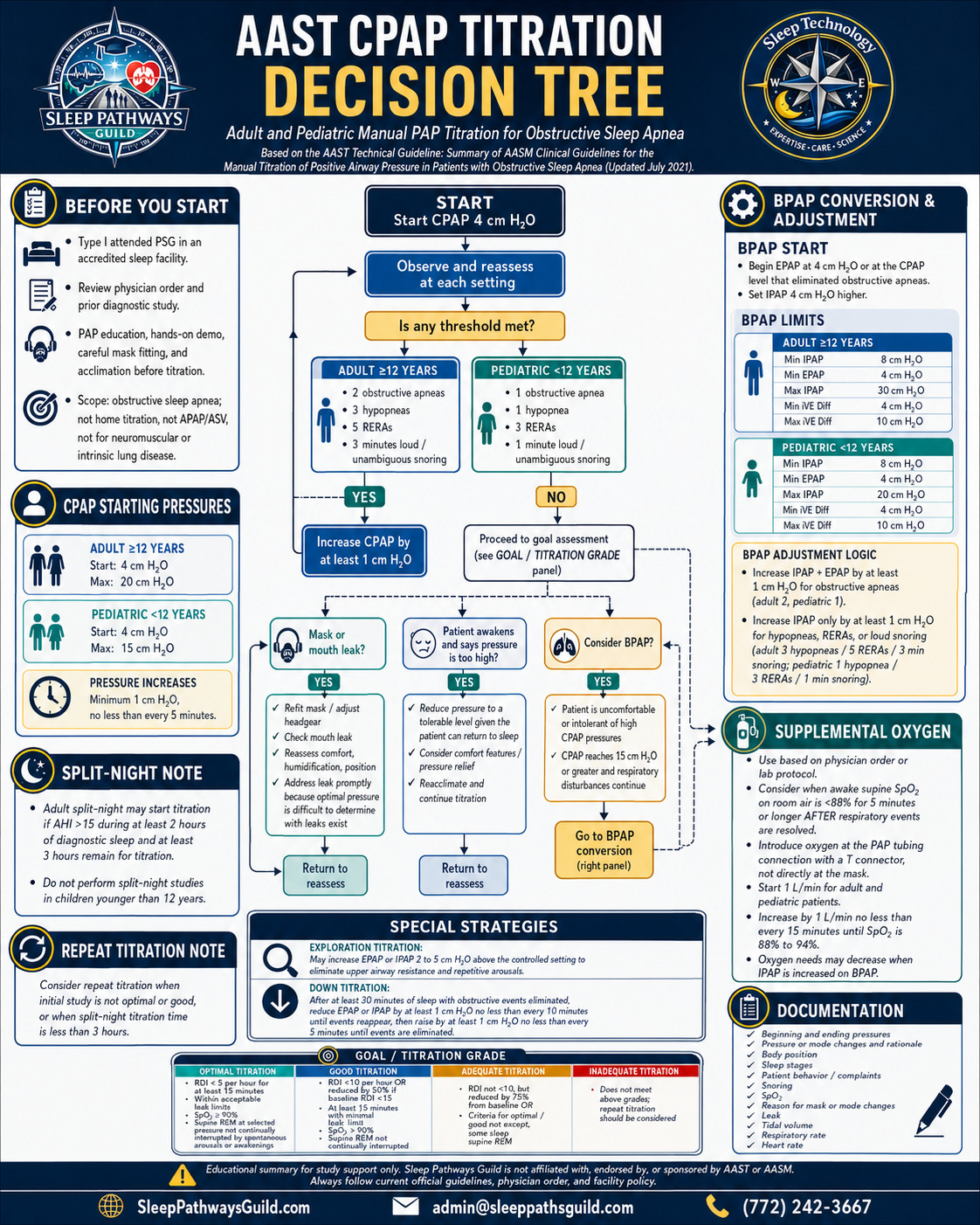
Use this free CPAP decision tree as an additional Domain 4 study tool. It reviews adult and pediatric CPAP titration concepts, starting pressures, reassessment, pressure increases, leak checks, BPAP consideration, supplemental oxygen, titration grading, split-night notes, repeat titration notes, and documentation reminders.
Domain 4 Artifact Example: CPAP Mask Leak Artifact
PAP leak can distort airflow, reduce effective pressure, and make therapy look worse than it really is. A leak problem can trick the learner into thinking pressure must be increased, when the first move may be to check the seal, mask fit, mouth leak, tubing pull, humidification, nasal congestion, or patient comfort.
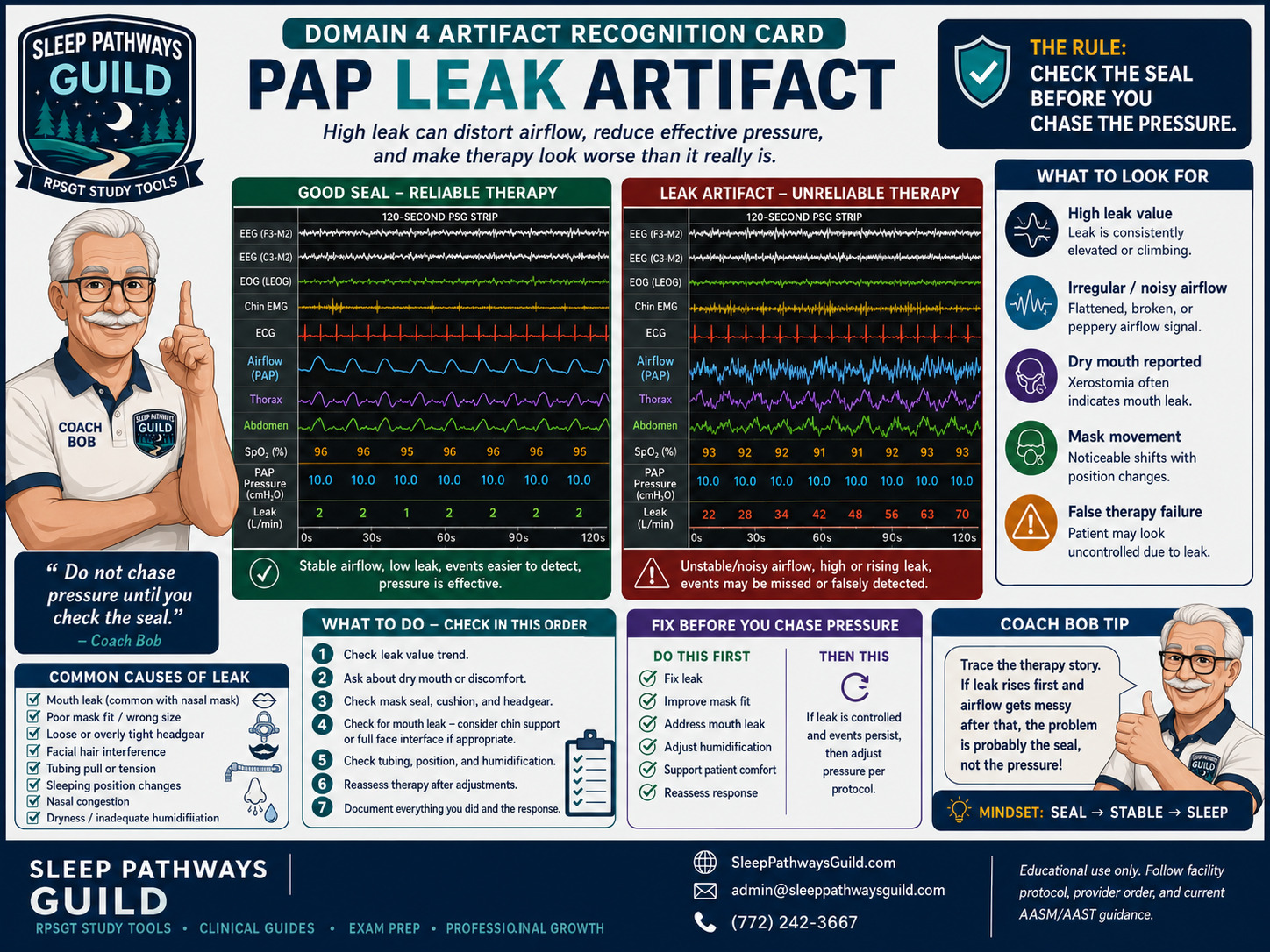
Open the CPAP Mask Leak Artifact Card
Coach Bob Artifact Rule
Do not chase pressure until you check the seal. If leak rises first and airflow becomes messy after that, the problem may be the mask seal or mouth leak, not the pressure setting.
AAST-Informed CPAP Titration Snapshot
Manual PAP titration is performed during attended polysomnography. The technologist observes respiratory and sleep disturbances, monitors patient response, and adjusts pressure according to protocol and physician direction.
| Topic | Adult ≥12 years | Pediatric <12 years |
|---|---|---|
| Minimum CPAP | 4 cm H₂O | 4 cm H₂O |
| Maximum CPAP | 20 cm H₂O | 15 cm H₂O |
| Pressure increase | At least 1 cm H₂O, no less than every 5 minutes when criteria are met. | At least 1 cm H₂O, no less than every 5 minutes when criteria are met. |
| CPAP increase triggers | 2 obstructive apneas, 3 hypopneas, 5 RERAs, or 3 minutes of loud/unambiguous snoring. | 1 obstructive apnea, 1 hypopnea, 3 RERAs, or 1 minute of loud/unambiguous snoring. |
BPAP Conversion and Mode Context Snapshot
BPAP conversion should always be interpreted in context. A titration guideline may describe pressure ranges, but the actual allowable settings depend on the ordered therapy mode, the device being used, manufacturer limits, facility protocol, patient tolerance, and medical director or physician guidance.
Important Mode Caution
Do not treat “BPAP” as one single setting pathway. BPAP S, BPAP S/T, auto-bilevel, VAuto-style modes, NIV modes, ASV, and volume-assured modes are not the same. Pressure limits, backup rate availability, pressure support behavior, and clinical purpose vary by mode and device.
| Concept | Study Point | Safety Context |
|---|---|---|
| When to consider BPAP | BPAP may be considered when the patient is uncomfortable or intolerant of higher CPAP pressures, or when respiratory disturbances continue at higher CPAP levels according to protocol. | This does not mean every patient should be changed to BPAP. Confirm the order, protocol, clinical context, patient tolerance, and provider direction. |
| EPAP role | EPAP primarily helps splint the upper airway and treat obstructive apneas. | Too little EPAP may allow obstructive apneas to return. |
| IPAP role | IPAP and pressure support may help address residual hypopneas, RERAs, snoring, flow limitation, ventilation needs, and comfort depending on mode and protocol. | Do not assume IPAP can be increased indefinitely. Follow the device, mode, order, and lab policy. |
| Pressure support | Pressure Support = IPAP - EPAP. | Pressure support range depends on mode and device. Excessive or inappropriate pressure support can change ventilation and patient comfort. |
Coach Bob Tip
Before you quote a pressure limit, name the mode. BPAP S, BPAP S/T, auto-bilevel, ASV, and NIV-style modes have different purposes and device limits. In real titration, the order, protocol, patient response, and device capability all matter.
Bonus Mini Lesson: Xerostomia and PAP Therapy
Xerostomia means dry mouth. In Domain 4, this matters because dry mouth during PAP therapy can be a clue that the patient is experiencing mouth leak, inadequate humidification, poor mask fit, nasal obstruction, medication-related dryness, or difficulty tolerating therapy.
Dry mouth during nasal PAP may suggest air escaping through the mouth.
Dry airflow may worsen mouth, throat, or nasal symptoms.
Poor fit can increase leak and reduce therapy effectiveness.
Do not diagnose. Troubleshoot within policy and document clearly.
Study Tracker
Check these off as you review.
25 Practice Questions With Click-to-Reveal Answers
1. What is the minimum starting CPAP pressure for an adult PAP titration?
Topic: CPAP starting pressure
A. 2 cm H₂O
B. 4 cm H₂O
C. 8 cm H₂O
D. 10 cm H₂O
Reveal answer
Rationale: Adult CPAP titration commonly starts at 4 cm H₂O.
2. What is the maximum CPAP pressure listed for adults 12 years and older?
Topic: CPAP pressure limits
A. 10 cm H₂O
B. 15 cm H₂O
C. 20 cm H₂O
D. 30 cm H₂O
Reveal answer
Rationale: Adult CPAP maximum is listed as 20 cm H₂O in the titration guideline summary.
3. What is the maximum CPAP pressure listed for pediatric patients under 12 years?
Topic: Pediatric CPAP pressure limits
A. 8 cm H₂O
B. 10 cm H₂O
C. 15 cm H₂O
D. 20 cm H₂O
Reveal answer
Rationale: Pediatric CPAP maximum is lower than the adult maximum.
4. During adult CPAP titration, pressure may be increased after observing:
Topic: Obstructive apnea threshold
A. 1 eye blink
B. 2 obstructive apneas
C. 1 sleep spindle
D. 1 isolated PVC
Reveal answer
Rationale: Adult CPAP pressure increases may occur when adult event thresholds are met.
5. During pediatric CPAP titration, pressure may be increased after observing:
Topic: Pediatric obstructive apnea threshold
A. 1 obstructive apnea
B. 5 obstructive apneas
C. 10 RERAs
D. 5 minutes of artifact
Reveal answer
Rationale: Pediatric pressure-increase thresholds are different from adult thresholds.
6. What is the minimum interval between CPAP pressure increases when criteria are met?
Topic: Pressure timing
A. No interval is required
B. At least 1 minute
C. No less than 5 minutes
D. At least 60 minutes
Reveal answer
Rationale: Pressure changes need time for stabilization and assessment.
7. An adult has persistent hypopneas during CPAP titration. Which threshold supports increasing CPAP?
Topic: Hypopneas
A. 1 hypopnea
B. 2 hypopneas
C. 3 hypopneas
D. 10 hypopneas only
Reveal answer
Rationale: Adult CPAP titration may increase pressure after 3 hypopneas.
8. An adult has persistent RERAs during CPAP titration. Which threshold supports increasing CPAP?
Topic: RERAs
A. 1 RERA
B. 3 RERAs
C. 5 RERAs
D. 10 RERAs only
Reveal answer
Rationale: Adult titration thresholds include 5 RERAs.
9. During pediatric CPAP titration, which snoring threshold supports a pressure increase?
Topic: Snoring threshold
A. 1 minute of loud or unambiguous snoring
B. 3 minutes of loud snoring
C. 10 minutes of quiet breathing
D. Snoring is never used
Reveal answer
Rationale: Pediatric thresholds differ from adult thresholds.
10. Why is mode context important when discussing BPAP pressure limits?
Topic: BPAP mode context
A. All BPAP modes have identical pressure limits
B. BPAP S, BPAP S/T, auto-bilevel, ASV, and NIV-style modes may have different capabilities and clinical purposes
C. Mode does not matter during titration
D. BPAP is only used for oxygen therapy
Reveal answer
Rationale: A pressure range should not be taught without naming the mode, device context, physician order, and facility protocol.
11. What should the technologist check before assuming a BPAP pressure limit applies?
Topic: Device and mode limits
A. Device specifications, ordered mode, lab protocol, and physician direction
B. Only the color of the mask
C. Only the patient’s pillow position
D. Nothing, because all machines are identical
Reveal answer
Rationale: Guideline tables support learning, but real-world titration must match the exact device, mode, order, and facility policy.
12. When starting BPAP, what does pressure support mean?
Topic: Pressure support
A. CPAP plus oxygen flow
B. IPAP minus EPAP
C. EPAP minus heart rate
D. Leak minus respiratory rate
Reveal answer
Rationale: Pressure Support = IPAP - EPAP.
13. On BPAP, obstructive apneas are generally addressed by increasing:
Topic: Obstructive apneas on BPAP
A. EPAP, often with IPAP adjusted to maintain the ordered pressure support relationship
B. Oxygen only
C. Humidity only
D. Video brightness
Reveal answer
Rationale: EPAP is the pressure component that helps splint the upper airway and control obstructive apneas.
14. On BPAP, residual hypopneas, RERAs, and snoring may be addressed by adjusting:
Topic: Residual events
A. IPAP or pressure support, depending on mode and protocol
B. ECG gain only
C. Body position sensor only
D. Room temperature only
Reveal answer
Rationale: Residual hypopneas, RERAs, snoring, or flow limitation may require IPAP-related adjustment, but mode and device limits matter.
15. Which is part of an optimal titration?
Topic: Optimal titration
A. RDI < 5/hr for at least 15 minutes at selected pressure within acceptable leak
B. RDI > 30/hr
C. No sleep recorded
D. No documentation
Reveal answer
Rationale: Acceptable leak is part of titration quality.
16. If mask or mouth leak is present during titration, what should the technologist do?
Topic: Mask leak
A. Ignore it
B. Promptly address leak
C. Increase pressure without checking the seal
D. Remove all respiratory channels
Reveal answer
Rationale: Leak can make optimum pressure difficult to determine.
17. A patient wakes and says the pressure is too high. What is the best response?
Topic: Pressure intolerance
A. Reduce to a tolerable level so the patient can return to sleep, per protocol
B. Increase pressure immediately
C. Ignore the complaint
D. End the study automatically
Reveal answer
Rationale: Successful titration requires the patient to sleep.
18. Supplemental oxygen during PAP titration should generally be introduced:
Topic: Oxygen connection
A. Directly at the mask
B. Into the PAP tubing connection using a T connector
C. Into the EEG electrode
D. Into the snore sensor
Reveal answer
Rationale: Oxygen delivery should follow protocol and equipment guidance.
19. What is the recommended minimum starting oxygen flow during PAP titration for adult and pediatric patients?
Topic: Oxygen flow
A. 0.25 L/min
B. 1 L/min
C. 5 L/min
D. 10 L/min
Reveal answer
Rationale: Oxygen is commonly started at 1 L/min and titrated per protocol/order.
20. Oxygen should be titrated in what increment and minimum interval?
Topic: Oxygen titration interval
A. 1 L/min no less than every 15 minutes
B. 5 L/min every minute
C. 10 L/min every 30 seconds
D. No titration interval is needed
Reveal answer
Rationale: Oxygen titration requires controlled adjustment and observation.
21. Why should oxygen not be used as a substitute for treating obstructive events?
Topic: Oxygen reasoning
A. Oxygen treats airway collapse directly
B. Oxygen may improve saturation but does not splint the airway open
C. Oxygen replaces all PAP pressure
D. Oxygen removes the need for documentation
Reveal answer
Rationale: Treat obstruction first, then address persistent hypoxemia per order/protocol.
22. Split-night studies should not be performed in which group according to the titration summary?
Topic: Pediatric split-night
A. Adults over 60
B. Children less than 12 years old
C. Adults with snoring
D. Adults with mild sleepiness
Reveal answer
Rationale: Pediatric split-night testing has special limitations.
23. Which documentation item is important during PAP titration?
Topic: Titration documentation
A. Beginning and ending pressures
B. Favorite TV show
C. The color of the blanket only
D. None of the above
Reveal answer
Rationale: Titration documentation should include pressures, mode changes, rationale, leak, oxygen, position, sleep stage, and patient response.
24. A PAP tracing looks unstable, leak is high, and the patient reports dry mouth with a nasal mask. What should the technologist suspect first?
Topic: CPAP mask leak artifact
A. Probable mouth leak or interface leak
B. Definite central apnea
C. REM sawtooth waves
D. Normal CPAP adaptation with no need to check leak
Reveal answer
Rationale: High leak with dry mouth during nasal PAP strongly suggests mouth/interface leak.
25. What does xerostomia mean?
Topic: PAP comfort and leak troubleshooting
A. Dry mouth
B. Low oxygen saturation
C. High carbon dioxide
D. Mask pressure setting
Reveal answer
Rationale: During PAP therapy, xerostomia may suggest mouth leak, inadequate humidification, nasal obstruction, or other comfort issues. Document the complaint and troubleshoot within facility protocol.
10 Glossary Terms
1. CPAP
Continuous Positive Airway Pressure; one continuous pressure used to help splint the upper airway open.
2. BPAP
Bilevel Positive Airway Pressure; PAP therapy using IPAP and EPAP. BPAP must always be interpreted by mode and device context.
3. IPAP
Inspiratory Positive Airway Pressure; the higher pressure delivered during inspiration on BPAP, depending on mode and device settings.
4. EPAP
Expiratory Positive Airway Pressure; the pressure that helps maintain upper-airway patency during exhalation.
5. Pressure Support
The difference between IPAP and EPAP. Pressure support = IPAP - EPAP.
6. RERA
Respiratory effort-related arousal; increased respiratory effort leading to arousal without meeting apnea or hypopnea criteria.
7. Mask Leak
Unintentional escape of airflow from the mask or mouth that can reduce therapy effectiveness and distort event detection.
8. Xerostomia
Dry mouth; during PAP therapy it may suggest mouth leak, dryness, nasal obstruction, poor fit, or other contributing factors.
9. Supplemental Oxygen
Oxygen added per physician order or protocol when oxygenation remains low despite appropriate management of respiratory events.
10. Optimal Titration
A titration meeting defined event control, oxygenation, leak, and sleep-stage/position goals at the selected pressure.
12 Flip-Style Flashcards
Click each card to reveal the back.
Flashcard 1 Front: What is Domain 4?
Back: Treatment and Intervention.
Flashcard 2 Front: What is the adult CPAP starting pressure?
Back: 4 cm H₂O.
Flashcard 3 Front: What is the pediatric CPAP starting pressure?
Back: 4 cm H₂O.
Flashcard 4 Front: Adult CPAP may increase after how many obstructive apneas?
Back: 2 obstructive apneas.
Flashcard 5 Front: Pediatric CPAP may increase after how many hypopneas?
Back: 1 hypopnea.
Flashcard 6 Front: What is the minimum interval between CPAP increases?
Back: No less than 5 minutes when criteria are met.
Flashcard 7 Front: What should be checked before chasing pressure?
Back: Leak, mask fit, mouth leak, patient comfort, sleep stage, position, and event type.
Flashcard 8 Front: What does xerostomia mean?
Back: Dry mouth.
Flashcard 9 Front: What does pressure support equal?
Back: IPAP minus EPAP.
Flashcard 10 Front: Why must BPAP be taught with mode context?
Back: BPAP S, BPAP S/T, auto-bilevel, ASV, and NIV-style modes can have different device limits, clinical goals, and backup-rate behavior.
Flashcard 11 Front: Where should oxygen be introduced during PAP titration?
Back: Into the PAP tubing connection using a T connector, per protocol/order.
Flashcard 12 Front: What should PAP titration documentation include?
Back: Pressures, mode changes, rationale, leak, oxygen, sleep stage, body position, patient response, and events observed.
References and Free Review Resources
Always use the most current official materials when preparing for an exam or performing clinical work.
AAST Titration Technical Guideline 2021
Summary of AASM Clinical Guidelines for the Manual Titration of Positive Airway Pressure in Patients with Obstructive Sleep Apnea.
AASM Clinical Practice Guideline: Treatment of Adult OSA with PAP
Patil SP, Ayappa IA, Caples SM, Kimoff RJ, Patel SR, Harrod CG. Treatment of adult obstructive sleep apnea with positive airway pressure:
an American Academy of Sleep Medicine clinical practice guideline. Journal of Clinical Sleep Medicine. 2019;15(2):335–343.
AASM Scoring Manual
Key reference for sleep staging, arousals, respiratory events, movements, cardiac events, and technical specifications.
https://aasm.org/clinical-resources/scoring-manual/
AAST Technical Guidelines
Professional technical resources for sleep technologists.
https://aastweb.org/clinical-resources/technical-guidelines/
BRPT RPSGT Exam Blueprint
Used for Domain 4 organization and exam-prep alignment.
https://brpt.org/rpsgt/exam-blueprint/
Sleep Pathways Guild
Free RPSGT study tools and sleep technology education.
SleepPathwaysGuild.com
Credit, References, and Educational Disclosure
This educational article was created by Sleep Pathways Guild for RPSGT study support, sleep technology education, and career-pathway awareness for learners exploring sleep technology credentials.
Sleep Pathways Guild is not affiliated with, endorsed by, sponsored by, or officially connected to AAST, AASM, BRPT, ABSM, NBRC, JCSM, or any exam board. Organization names and guideline titles are referenced for education, citation, and source identification only. All trademarks, organization names, credential names, manuals, and guideline titles belong to their respective owners.
No official BRPT exam questions are reproduced in this article. The practice questions are original RPSGT-style educational questions and should not be treated as a prediction of exam content.
This article does not replace official exam materials, current AAST technical guidelines, AASM clinical practice guidelines, the AASM Scoring Manual, facility policy, manufacturer instructions, clinical judgment, provider orders, medical director protocols, accreditation requirements, or applicable laws and regulations.
In clinical practice, always follow your facility’s approved policies, supervising provider instructions, emergency procedures, manufacturer instructions, and current professional standards.
Financial disclosure: Unless otherwise stated, Sleep Pathways Guild receives no payment, sponsorship, affiliate commission, or endorsement from AAST, AASM, BRPT, ABSM, NBRC, or JCSM for including these educational references.
AI/content disclosure: This educational draft may have been prepared with AI-assisted writing and design support and should be reviewed for accuracy, scope, and current guideline alignment before posting or use in instruction.
Linked references & resources
Official sources are prioritized. Book links open Amazon search results so readers can compare available editions.
- AASM Clinical Practice Guidelines
Official guideline collection.